


On this page
Peeling completeness and fibrousness should be checked separately when you evaluate frozen white asparagus. A visible strip of outer peel is a surface-preparation question. A spear that looks clean but resists the fork or leaves strings when eaten is a cooked-texture question. Either can make a plated spear or a prepared-food cut unsuitable, but they call for different evidence and different corrective discussions. Start with the exact frozen form you plan to buy, inspect comparable pieces for peel remnants, then cook a matched sample and record where any tough bite occurs. Agree the acceptable result with the supplier before treating a sample as an order benchmark.
Quick answer: Check the frozen or appropriately thawed surface for retained peel, then assess cooked tenderness by spear zone under one repeatable method. A clean surface does not prove a tender base, and a firm base does not automatically mean the peel was missed. Specify the form, size, inspection point, cooking method and acceptable finish instead of relying on a single description such as “fully peeled” or “not fibrous.”
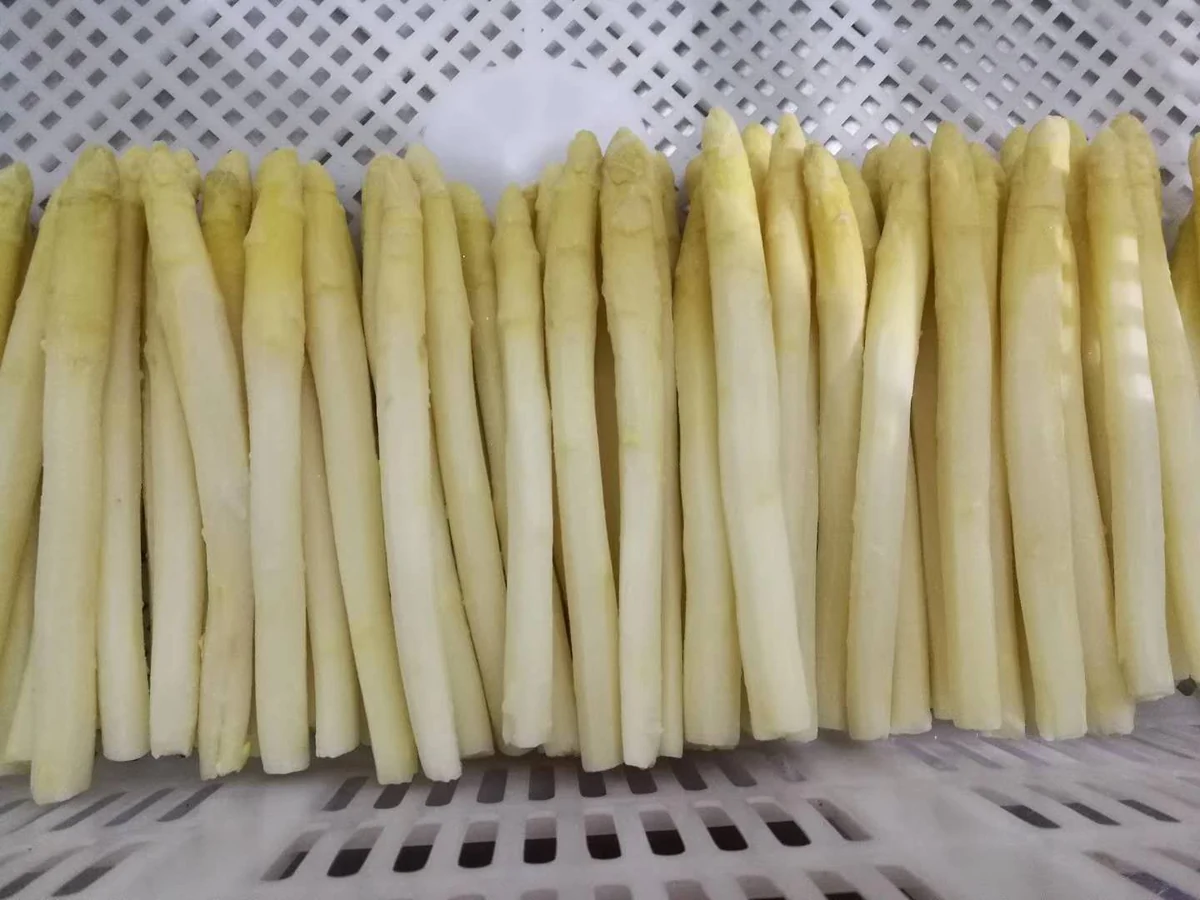
Whole spears expose a long surface and basal section to consider when defining the intended form.
A peel check and a fibre check answer different questions
White asparagus has an outer layer that cooks often remove from fresh spears because it can be tough or bitter. That familiar kitchen advice is a useful reason to ask about peeling, but it does not prove how a particular frozen product was prepared. The frozen bag might contain whole spears, tips, segments or dice. A buyer needs to know the intended peel state for that exact form and what the supplying operation regards as an unacceptable remnant. The phrase “peeled white asparagus” is only useful when both parties can recognize the expected surface on a sample.
Fibrousness is most meaningful after the product has been prepared as it will be eaten. You may see a pale spear with no obvious skin left and still encounter resistance at the lower part. Equally, a small visible strip on an otherwise tender piece is a presentation defect even if it does not change every bite. Keeping appearance and bite in separate fields prevents one observation from hiding the other. It also gives the supplier a usable question: was the problem incomplete surface preparation, the retained basal portion, the selected raw material, or the cooking comparison itself?
Research shows why the internal texture question deserves its own check. In a 1994 Journal of Food Science study of white asparagus [1], the researchers evaluated their samples with maximum shear force, cutting energy and total fibre content. Under their blanching and frozen-storage conditions, the abstract reports increased total fibre over storage and a correlation with lignification in the basal segment. Those are findings from the tested material, not measurements of XMG’s current products or a general rule that every frozen spear changes the same way. For a buyer, the useful lesson is narrower: location along the spear and preparation history can matter to the texture you approve.
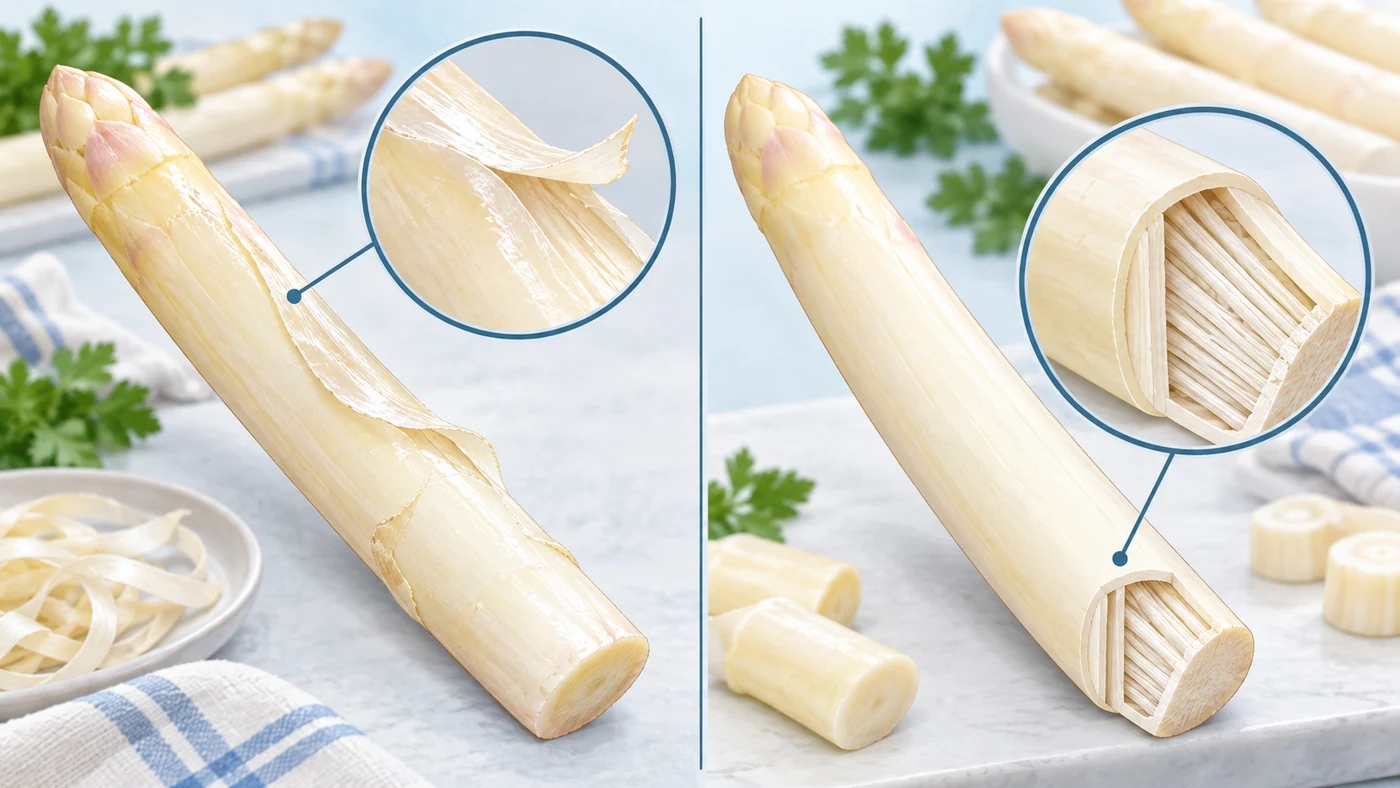
A visible outer peel strip and resistance within the cooked spear call for separate checks.
Where along the spear is the problem?
A whole spear is not one uniform eating experience. The tip, middle and lower stem serve different visual and texture roles. In a plated presentation, a tender head and a stringy base can exist on the same piece. If a sample is reported simply as “fibrous,” the word does not tell you whether diners are biting into one problematic end, whether the issue runs along the whole spear, or whether the planned trimming already removes that portion.
Divide a review into practical zones. Record the head or tip condition, the middle section used for the principal bite, and the basal section closest to the cut end. You do not need to invent a universal distance from the base. Mark the point where a fork begins to resist, where a chew feels stringy, or where trimming becomes necessary in that sample. Compare spears of the same declared form and size range so a larger whole spear is not quietly judged against a smaller cut or tip.
For diced or cut product, the zone may be less visible after freezing. That makes the supplier’s cut definition more important. Does the cut pack include lower-stem pieces, and if so, how should their cooked texture be judged in the finished dish? A short piece in soup may be acceptable where a long, plated spear would draw attention to a tough base. The ingredient’s function changes the tolerance discussion; it does not make tough fibre disappear.
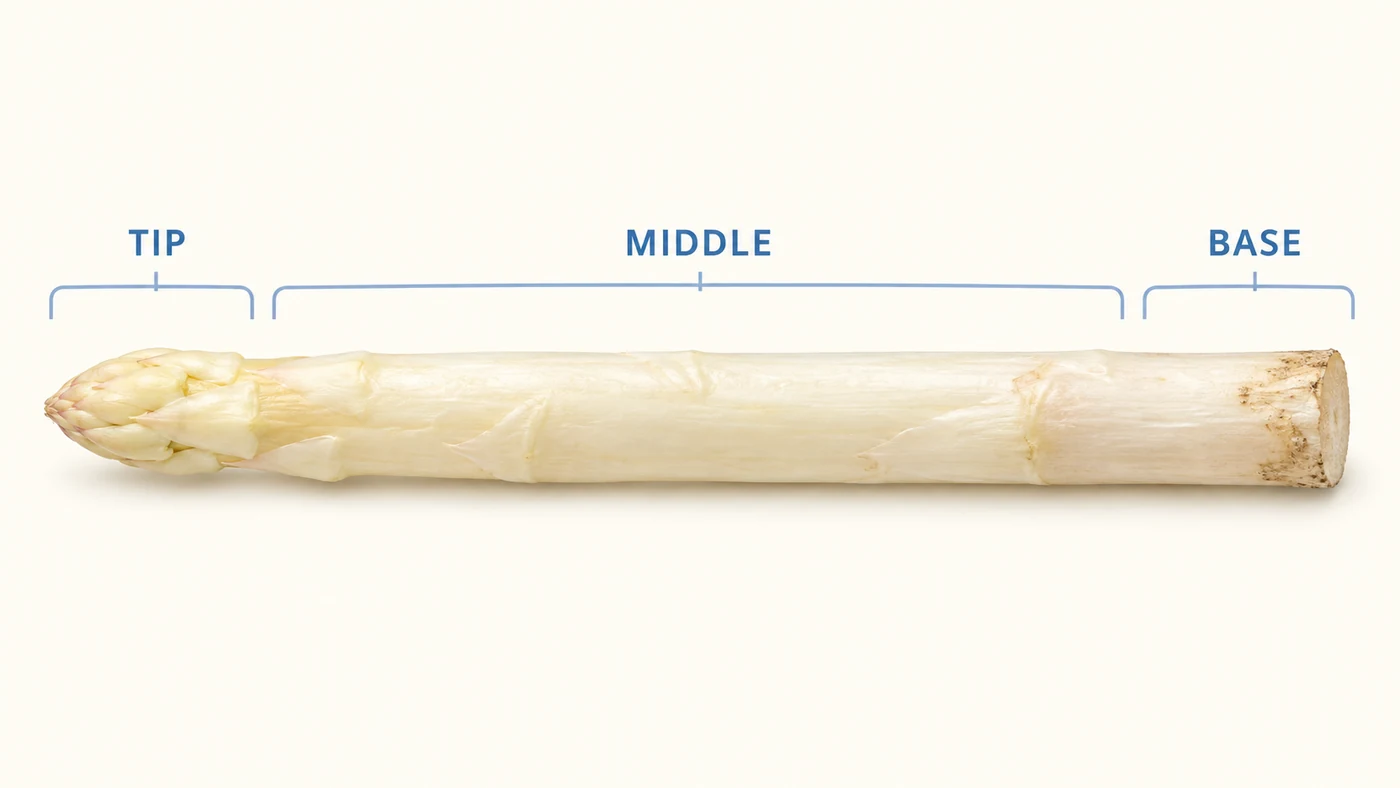
Record whether an observed texture issue occurs near the tip, middle or base.
USDA’s frozen-asparagus inspection instructions [2] illustrate why appearance alone is an incomplete texture check: within their covered green and green-white types, inspectors use a cooked fork test and chewing to determine tough fibre. The same document explicitly places culturally bleached white asparagus outside its frozen-type description. We therefore use the fork-and-chew idea only as a practical comparison method, not as a claim that a frozen white-asparagus lot carries a USDA grade or must meet those instructions’ defect allowances.
Keep the comparison on the same product form
One bag described as white asparagus can represent several quite different buying decisions. XMG’s IQF white asparagus product page lists whole spears, tips, cuts and dice and identifies peeling and fibre among the product-specific controls to confirm. The article’s method should therefore begin with the proposed form, not an abstract “white asparagus” sample. A whole-spear retail pack exposes the full surface and lower stem to the diner; a cut ingredient brings a distribution of spear zones into a sauce or ready meal.
Ask whether the intended product is fully peeled, partially peeled, or specified in another way. Record the declared cut and size range, whether the head is retained, whether the basal section is included, and whether you will inspect the frozen surface, an appropriately thawed piece, or a cooked portion. Those stages reveal different things. Frost can hide a thin peel strip. Cooking can make a fibre issue obvious that the frozen appearance did not reveal. Without a named stage, two teams may honestly report different findings from the same style of product.
A matched comparison also needs one cooking basis. If the first sample is boiled until very soft and the second is reheated briefly, their fork resistance cannot be read as a product difference alone. Match the portion size, cooking medium, target doneness and hold period that matter to your operation. Follow the supplier’s preparation instructions, then document any application-specific variation you introduce. If the product will be served after a hold, evaluate it after that hold; if it will be diced into a filling, evaluate it in a filling-compatible preparation. The method should represent the intended use, not an arbitrary laboratory performance claim.
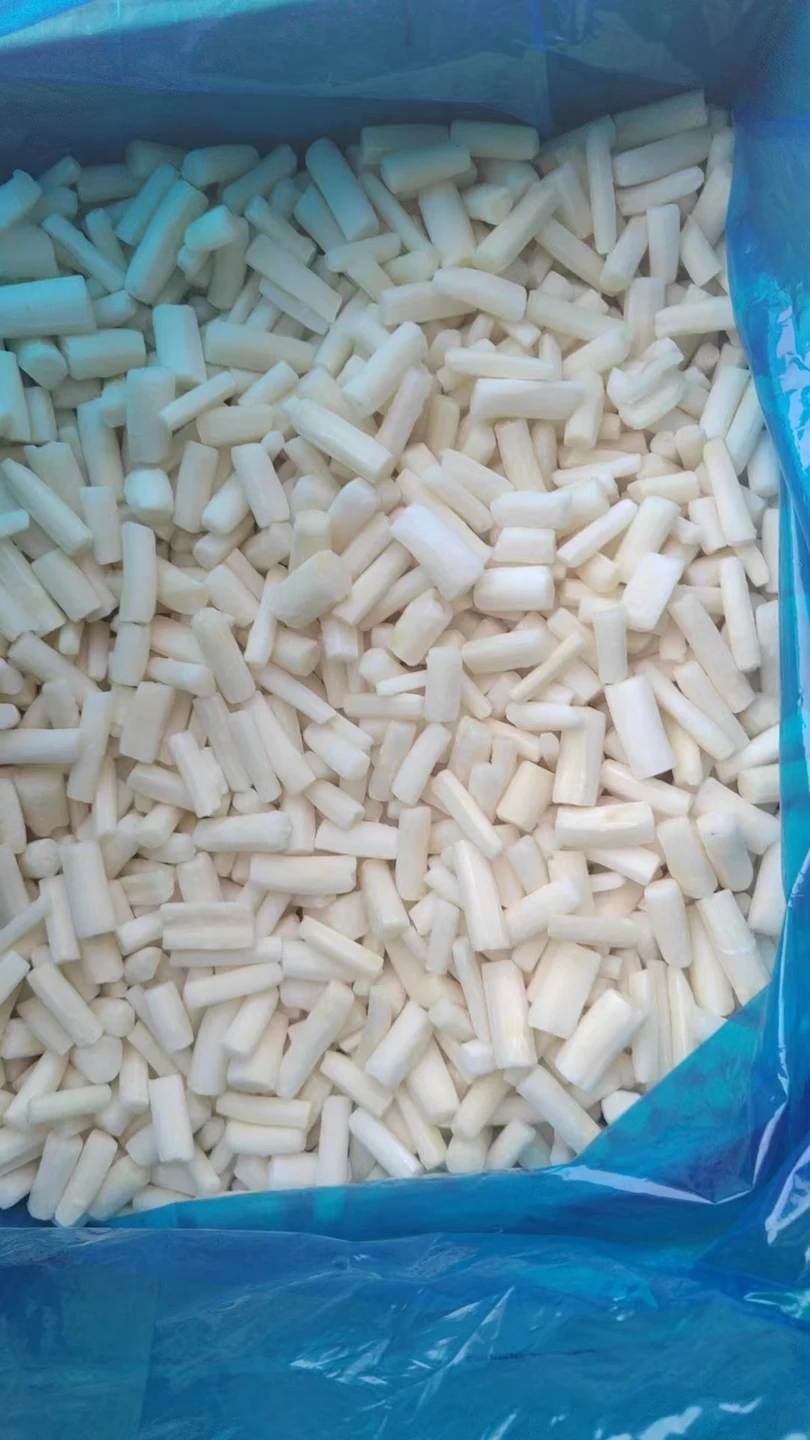
Cut segments bring a different mix of spear zones into a finished dish than whole spears.
A repeatable sample review
The first step is to write down what “good” means for the dish. For a plated whole spear, the appearance of the surface, head integrity and a clean fork-through bite may all be visible to the customer. For an ingredient cut, the amount of lower-stem material and the texture of a representative cooked portion may matter more than the appearance of every individual piece. State those priorities before opening a carton so the review does not become a retrospective explanation of whatever the sample happens to show.
- Identify the sample. Note product form, declared size or cut, pack identity, sample identity, supplier instructions and intended application. Keep approval samples and later production or lot samples distinguishable.
- Inspect the surface. Spread a representative set of pieces where the surface can be seen. For whole spears, look around the circumference and along the length rather than viewing only one front-facing side. Photograph any suspected peel remnant with scale and location noted. Describe what is visible without naming every pale ridge a defect.
- Prepare matched portions. Use the same cooking method for like-for-like samples and record the method. Follow the product’s directions. Keep heads, middle sections and bases identifiable where the form permits.
- Assess the cooked bite. Note whether a fork passes through cleanly, whether the chew leaves persistent strands, and where that occurs. If trimming is needed, identify the portion removed and how it affects usable yield in the intended application.
- Make the decision explicit. Separate surface appearance, cooked texture and practical trim loss in the review record. Decide what needs supplier clarification, what calls for a revised specification, and whether a new sample is needed.
Write the acceptance language for the named product and application. If you need a numerical tolerance for peel remnants or a measurable texture criterion, agree the defect definition, sampling basis, test method and limit together. A number without a method can sound precise while leaving the real disagreement unresolved.
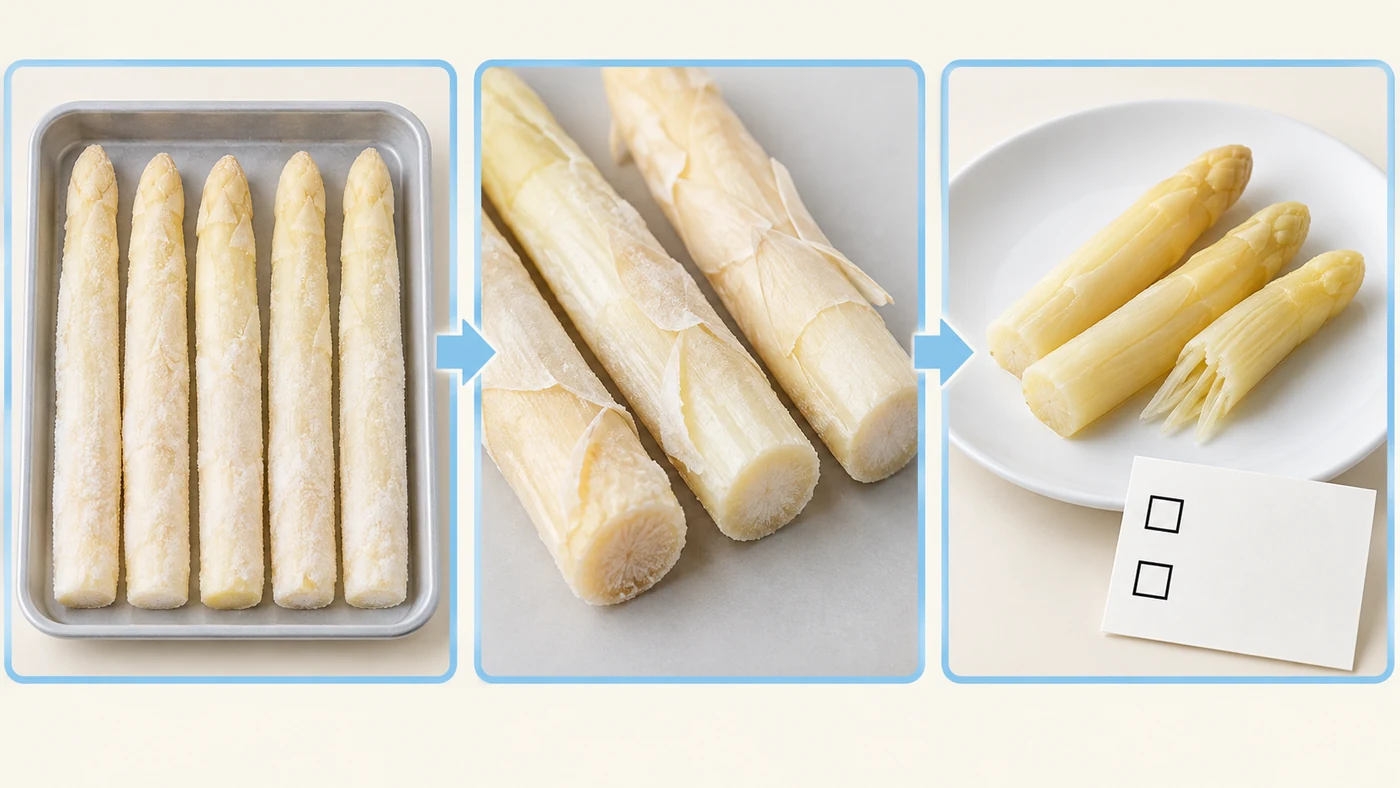
Compare matching pieces, check the surface, then assess cooked bite under one stated method.
Interpret the result before changing the specification
| Observation | What it may mean | What to check next |
|---|---|---|
| A distinct outer strip remains on an otherwise tender spear. | Possible peel-coverage or presentation issue. | Confirm the agreed peeled state and record strip location and frequency under an agreed sample basis. |
| The surface looks clean, but the basal bite is stringy. | A lower-stem texture or trim issue may remain despite visible peeling. | Repeat the cooked assessment by spear zone and measure practical trim for the dish. |
| All pieces are firmer than expected. | Product, size, preparation and cooking method all remain possible variables. | Check like-for-like size and method before attributing the difference to peeling or fibre. |
| Pieces are tender, but the plated form looks uneven. | Appearance may fail an application even if cooked texture passes. | Record visible peel, head and cut presentation as separate specification fields. |
These are diagnostic questions, not automatic defect verdicts. A visible fibre-like line can be normal tissue, while an unobtrusive looking piece may still chew poorly. The decision improves when you retain a photograph, a cooked note and the relevant spear zone rather than a single adjective. If the supplier disagrees, the shared sample and method give both teams something concrete to revisit.
The 1994 research also argues against blaming every tough bite on peeling alone. The researchers’ measured texture and fibre response involved their treated white-asparagus samples and storage protocol. It provides scientific support for treating internal texture as a distinct phenomenon. It does not provide a universal commercial limit, does not establish the current condition of an XMG product, and should not be used to assign a shelf life to a new order.
The same result can matter differently by application
Whole plated spears: The diner sees most of the surface and may cut through a long lower section. Residual peel and a tough base are both conspicuous. Specify the expected length and diameter alongside peel condition and the cooked result. If trimming is part of the kitchen workflow, decide how much usable spear must remain after that trim; a nominal whole-spear length alone does not describe the plated yield.
Tips: The head presentation is often the reason for selecting the format. Surface condition and head integrity remain visible, while the retained stem length determines how much lower tissue enters the bite. Do not assume that a tip automatically avoids all fibrousness; assess the supplied cut and its intended cooking method.
Segments and dice: Small pieces may be dispersed through soup, sauce or a prepared meal, so a single long peel strip could be more noticeable than a modestly firm bite. Conversely, basal tissue distributed through a dish can create repeated stringy pieces that are hard to trim in the kitchen. Agree how much of each spear zone is included and evaluate a representative cooked portion. The buyer’s target might differ for a blended soup, a visible vegetable mix and a pastry filling.
For a broader comparison of how diameter, woody ends, peeling and trim yield can be separated in a cooking trial, see our green-asparagus cooking-trial guide. Its product and data are not a substitute for a white-asparagus approval sample. The useful transferable idea is methodological: hold the comparison conditions steady and report the consequence in usable food, not just an abstract defect label.
What to put in a white-asparagus approval brief
Start the brief with the frozen form, size range and finished use. Then specify the intended peel state, the point at which peel coverage will be examined, the cooked preparation, the spear zones or cuts to assess, and the texture outcome that is unacceptable to your customer. Add how a disputed piece will be documented and how many pieces or packs are represented in a decision. If a numerical tolerance is needed, define its measurement basis and approval stage with the supplying route before placing it in a purchase order.
It helps to separate three records. The written specification describes what you expect. The approved sample shows a tangible reference under a stated method. The later lot or shipment evidence identifies what was actually supplied. Keeping those linked prevents an attractive photograph or one tender spear from becoming an unsupported claim about every case. XMG’s specifications and sampling process describes how product identity, method and approval scope are recorded for an order; it is a useful companion when a buyer needs to turn a sensory expectation into a reviewable requirement.
Frozen White Asparagus
Review our white-asparagus forms and discuss the specification for your finished use.
Explore Frozen White Asparagus →References
- [1] Sánchez-Pineda-Infantas et al., “Blanching, Freezing and Frozen Storage Influence Texture of White Asparagus,” Journal of Food Science 59(4), 821–823 (1994)↑. Findings cited here apply to the study’s tested white-asparagus samples and conditions.
- [2] USDA AMS, Frozen Asparagus Inspection Instructions (2015)↑. Cited only for the scope-limited fork/chew inspection-method analogy; its frozen type description does not cover culturally bleached white asparagus.
