


On this page
Lotus root is the edible underground stem, or rhizome, of the lotus plant. Its pale cross-section is marked by a ring of open channels, while the flesh is mild, lightly sweet and usually described as crisp or starchy. In a dish, the cut matters as much as the name: full rounds keep the familiar wheel pattern visible, while quarters, dice and strips change how easily the pieces mix and portion. Frozen lotus root can be a convenient starting point, but its final bite depends on the product’s preparation and the way it is cooked. Check the package directions, choose a cut for the finished dish, and judge the texture after that dish is prepared.
In short: choose rounds when the lotus-root pattern should be seen, smaller pieces when even distribution or quick portioning matters, and strips when a narrow shape suits the bite. Frozen pieces do not guarantee the same texture as fresh-cut root. Follow the directions for the actual product and compare it in the recipe where it will be served.

A cut lotus root round shows the open channel pattern that makes the ingredient easy to recognise.
What part of the plant is eaten?
The part sold as lotus root is a rhizome: a horizontal underground stem that stores energy and produces roots and shoots. It grows in wet ground beneath the lotus plant. The word “root” is the familiar food name, although botanically the edible structure is a stem. The distinction helps explain why a whole piece has a segmented, sausage-like form rather than the branching shape many people associate with a root vegetable.
Cut across the rhizome and the channels appear as holes arranged in a repeating pattern. They continue lengthwise through the piece, which is why a round slice can look like a small wheel. The number, size and position of the openings vary with the natural form of the piece; they are not a decorative addition or a measure of eating quality by themselves. An Australian vegetable-industry profile [1] describes lotus root as a rhizome and documents its use as a food, while FreshPoint’s produce guide [2] also describes the cross-section and culinary identity. These references help identify the ingredient, but they do not define a frozen-product grade.
That wheel pattern is useful in the kitchen. A complete round is easy to recognize in hotpot, a vegetable platter or a visible garnish. When the same piece is quartered, diced or cut into strips, fewer complete rings remain in each bite. That can be desirable when the root should distribute through a filling or stir-fry rather than sit as a large, distinct slice. The visual result follows from geometry; it does not establish a different species or a guaranteed difference in texture.

The edible rhizome runs below the water; its lengthwise passages appear as holes across a cut face.
How does lotus root taste and feel?
Fresh lotus root has a mild flavour that can seem lightly sweet, with a clean, starchy character. Many cooking references compare its fresh crunch to other firm vegetables, but such comparisons are only a starting point. Variety, maturity, piece dimensions, freshness, prior handling and the cooking method all affect what a person notices. “Crunchy” alone is not a complete texture description: a bite may break cleanly, feel firm through the center, soften at the surface, or become tender after longer cooking.
Cooking changes the experience. A brief stir-fry, a simmer in soup and a longer braise expose lotus root to different heat and moisture conditions. A published study [3] measured texture and flavor changes in fresh lotus root after boiling, steaming and frying under its tested conditions. It shows why cooking method belongs in a texture discussion; it does not set one ideal bite for every recipe, and it did not establish a universal result for frozen commercial product. Use the study as support for the general point that preparation affects measured texture, not as a timing chart for a bag in your freezer.
Fresh slices can also darken after cutting when exposed to air. [4] and other culinary references describe limiting that change during fresh preparation. That observation concerns cut fresh root. It does not tell you how a frozen product was treated before packing or what color it should have after cooking. If appearance matters, compare the actual product at the same stage and use its instructions rather than applying a fresh-root soaking step automatically.
A helpful way to describe the desired bite is to name the dish and the moment of eating. For a hotpot slice, should the piece remain easy to pick up after simmering? For a filling, should small pieces stay distinct or blend into the mixture? For a stir-fry, should a strip remain noticeable after the other ingredients are added? These descriptions tell a cook more than a broad request for “crunchy lotus root,” and they avoid promising that every cut will behave alike.
How do cuts change use?
Cut affects visibility, surface area, portioning and the way a piece sits among other ingredients. XMG’s current product page lists slices, quarter slices, diced pieces and strips. The names describe shape; they do not by themselves specify the exact preparation state, cooking requirement or finished bite. For current dimensions and purchase-specific details, use the product page and confirm the actual offer.
| Cut | What stays visible | Where it may fit | What to check |
|---|---|---|---|
| Full slices | The ring of channels remains easy to recognize. | Hotpot, soups, braises or dishes where a visible round is useful. | Whether the piece size and bite suit the spoon, chopsticks or serving portion. |
| Quarter slices | Part of the channel pattern remains, in a shorter arc. | Portioned meals or mixed dishes where full rounds would be large. | How the smaller arcs distribute and whether they stay identifiable after cooking. |
| Dice | Individual holes are less prominent in each small piece. | Fillings, mixed vegetables or recipes that need even small portions. | Whether the pieces remain separate enough for the intended filling or blend. |
| Strips | A narrow piece makes the longitudinal shape more noticeable than a full wheel. | Stir-fries, salads or recipes that use slender vegetable pieces. | How the strip length fits the bite and whether the cut is distributed evenly. |
This table is a selection aid, not a performance ranking. One cut is not automatically more tender, crisp or convenient than another. A thick round and a thin round differ in more than appearance; a diced piece and a strip also expose different surfaces and occupy the dish differently. Where the finished bite is important, assess the declared cut as supplied and after the preparation you intend to use.

Quarter-cut lotus root pieces retain part of the channel pattern while dividing a full round into smaller portions.
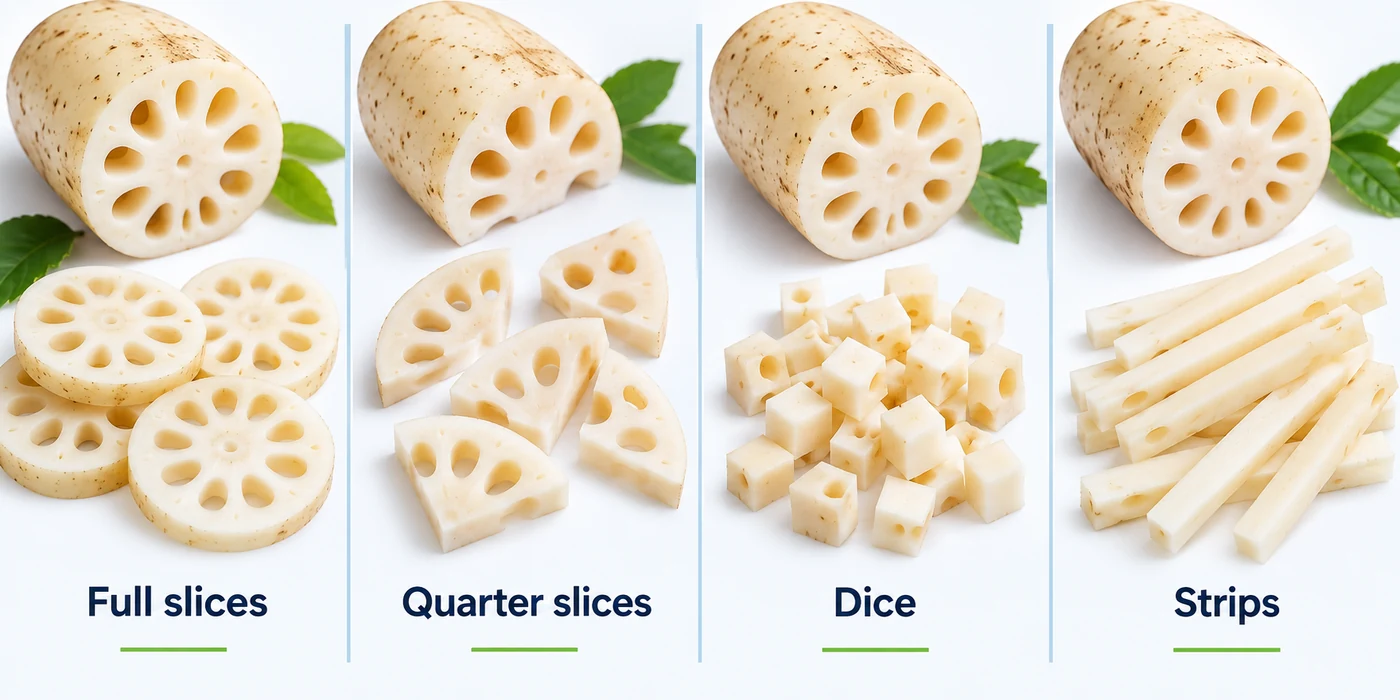
Four lotus root cut shapes change how much of the ring remains visible and how pieces spread through a dish.
What changes when lotus root is frozen?
A frozen cut gives the kitchen a different starting point from a freshly cut rhizome. It arrives in a defined form and must be handled according to its own label and preparation directions. “Frozen” describes its storage state; it does not tell you whether the product has been blanched or otherwise pretreated, whether it requires cooking, or whether it is ready to eat. Do not infer those details from a photo, the cut name or the fact that pieces are individually frozen.
Start by reading the actual pack instructions. Confirm the product name, form, storage guidance and any cooking direction before deciding whether to thaw, rinse, drain or add it directly to a dish. The manufacturer’s directions for that product take priority over a fresh lotus-root recipe. If the package does not answer a question important to your recipe, confirm it with the supplier instead of filling the gap with an assumption. Different products sold under the same ingredient name may have different preparation histories.
Fresh preparation advice does not automatically transfer to frozen root. A recommendation to soak newly cut slices to manage surface discoloration is about freshly exposed flesh. A frozen product may have its own cut and treatment history, and adding water without checking the directions may change the starting conditions. In the same way, a cooking time written for fresh thin slices should not be copied as the required time for thicker frozen pieces. Use the recipe’s visual and texture endpoint only after following the frozen product’s directions.
Frozen pieces can also differ in how they separate and portion. If the package presents loose pieces, weigh or count the amount required in the same way you normally prepare the dish. If pieces are clumped, frosted or difficult to separate, consult the handling directions and supplier rather than forcing them apart in a way that breaks the cut. The condition you actually receive is part of the practical question. A perfect-looking photograph of one piece does not describe the whole pack.
For product-level comparisons, keep preparation status explicit. A round slice, a quarter and a diced piece may all be lotus root, yet they do not enter the recipe in the same way. If samples differ in both cut and prior treatment, any difference observed in the cooked dish belongs to those complete product options; it cannot be attributed to cut alone. This is why actual product details matter before drawing a broad conclusion about frozen lotus root.

Fresh-cut and frozen cuts begin at different preparation stages; check the actual frozen product directions before cooking.
Choose a cut by the finished dish
Begin with what the eater should see and feel, then choose the closest shape. In a hotpot, a full round may be useful because the characteristic channels remain visible in the bowl. In a portioned meal, quarter slices can offer a smaller recognizable piece. Dice may work where the root is one ingredient among several in a filling. Strips may make more sense when the recipe is built around narrow vegetables. These are practical starting points based on shape and use, not claims that a specific format wins in every recipe.
Now define the texture at the serving stage. A slice served soon after simmering may feel different from one held warm, chilled, reheated or mixed with a sauce. Write down the point that matters: immediately after cooking, after the normal hold, or after the usual reheating step. The lotus-root texture study cited below shows that cooking methods can change texture in fresh material under tested conditions; it does not predict the response of every frozen product or prepared meal. For that, the actual product and process have to be considered together.
Decide what should happen to the other ingredients as well. In a soup, should lotus root remain a distinct piece while the broth carries the rest of the flavor? In a stir-fry, should it be easy to pick up with the other vegetables? In a filling, should it remain visible after mixing? These questions affect the useful cut and the observation you make. A visually attractive piece before cooking is not enough to confirm that the finished dish has the right distribution.
A simple kitchen comparison can help when two forms are both plausible. It is a proposed method, not a published XMG test or a claim about a particular batch:
- Identify each product. Record the name, declared form, package directions and the amount used. Keep frozen products identified separately through preparation.
- Use the same recipe basis. Keep the base ingredients, equipment, portion size and serving point consistent where practical. Follow each product’s directions if they differ, and note that difference.
- Observe the finished dish. Note whether pieces are recognizable, how evenly they are distributed, whether they remain intact enough for the serving style, and whether the bite meets the intended description.
- Choose the useful trade-off. If a full round looks right but is awkward to portion, a smaller form may fit better. If smaller pieces disappear into a filling, a more visible cut may be preferable. Record the reason for the choice rather than calling one format universally best.
Change one selection variable at a time when you want to understand a particular difference. If both the cut and the recipe change, you can still decide which complete dish you prefer, but you cannot tell which change caused the difference. For a quick menu choice, that distinction may not matter. For repeat preparation or a written product requirement, it matters more because another cook needs to recreate the result.
What to confirm in a frozen lotus-root offer
For a household purchase, the package directions may provide all the detail needed. For foodservice or product development, a short written description prevents the cut name from carrying more meaning than it should. Confirm the species or product identity, declared form, the size definition that matters to the application, any stated prior treatment, pack format and preparation directions. Ask which details are confirmed for the offer rather than assuming a page example applies to every order.
When a sample is considered, connect it to the intended recipe. Describe whether you need a visible hotpot round, a portioned meal piece, a filling component or a strip for a stir-fry. Agree how the sample will be prepared and at what stage its bite and appearance will be discussed. If the recipe normally includes holding or reheating, mention that at the beginning. An evaluation of a piece cooked once in a small pan may not answer a question about a finished meal that is chilled and reheated.
Keep expectations descriptive until there is an agreed basis for a specification. “The piece remains recognizable after the stated cook and hold” is a clearer starting point than “good quality.” If size, breakage, channel appearance, color or a texture target affects acceptance, define the reference, method and stage where it will be judged. Do not convert a single serving preference into a universal tolerance without agreeing how it is measured and applied.
For deeper questions about lotus-root slice thickness and cooked crispness, use the specialist guide to slice thickness and crispness after cooking. It addresses process conditions and measurement context.
Discuss a lotus-root cut with XMG
Tell us the finished dish, preferred slice, quarter, dice or strip, the piece size that matters, pack format, volume and destination. We can check the current frozen lotus-root offer and discuss a representative sample and written product details. Your team can then assess that named product after its stated preparation and the normal cooking or holding step for the dish.
Frozen Lotus Root
Review the listed cuts, then send your dish and order requirements from the product page.
View frozen lotus-root forms →References
- [1] AUSVEG, “Asian vegetable profile: Lotus Root,” Vegetables Australia, July/August 2010↑. Used for edible rhizome identification and industry context; this is a historical profile, not a current frozen specification.
- [2] FreshPoint, “Lotus Root”↑. Produce identification and general food-use description.
- [5] Just One Cookbook, “Lotus Root (Renkon)”. Culinary description, fresh preparation and cut examples.
- [4] Kikkoman, “Renkon / lotus root”↑. Fresh vegetable preparation guidance and common cuts.
- [3] “Changes in the Texture and Flavor of Lotus Root after Different Cooking Methods,” Foods 2023, 12(10), article 2012↑. Instrumental and sensory study of fresh material under the tested cooking methods; not a universal frozen-product result.
- XMG Food, IQF Frozen Lotus Root. Current listed forms and application context; offer-specific availability and product details require confirmation.
