


On this page
Bamboo shoots are the young, edible growth of certain bamboo species, harvested before the stem becomes woody. The food is the pale inner portion beneath a tough outer sheath. Fresh unprocessed shoots need peeling, trimming and appropriate cooking before eating. Canned, dried, fermented and IQF frozen shoots are different ingredients because their cuts and processing histories differ. If you buy frozen shoots, check the supplier’s declared treatment and the pack’s cooking directions; freezing by itself does not make a raw shoot ready to eat.
The practical choice starts with your dish. A long strip may show clearly in a stir-fry, a slice may hold its shape in hotpot, a dice can distribute through soup or filling, and a tip may be chosen for a visible piece. Those are application starting points, not a promise about every offered species, pack or cooked texture. Confirm a named product before writing the recipe or order specification.
What part of bamboo is eaten?

Illustration: the pale inner shoot is exposed after the tough sheath and fibrous base are removed.
A bamboo shoot is a new stem emerging from an underground rhizome. It is not the hard green pole used as a building material. The fresh cone is wrapped in fibrous leaf sheaths. Once those layers and the tough base are removed, the pale inner shoot can be cut for food. Only suitable edible species and parts should be used. The Washington State University Extension bamboo-shoot brochure [1] describes the young shoot, sheath removal and common kitchen uses.
The same name covers more than one commercial raw material. Species or trade type, shoot part, maturity and trimming can change the amount of fibrous tissue left in a piece. The tip, broader inner sections and base do not necessarily cook or chew the same way. A photograph can show the delivered cut, but it cannot identify the species or establish that the material has received the required treatment. Ask for that information in the product description when it matters to the dish.
Bamboo shoots contribute a mild flavour and a distinct bite, yet “crisp” is only useful when you say what remains intact after the real cooking and holding route. A soft dice in a dumpling filling and a visible slice in a broth have different jobs. For a controlled comparison of fibre and tenderness, the XMG guide to bamboo-shoot tenderness and fibre in a cooked sample covers a separate, more detailed trial.
Read the form before planning preparation
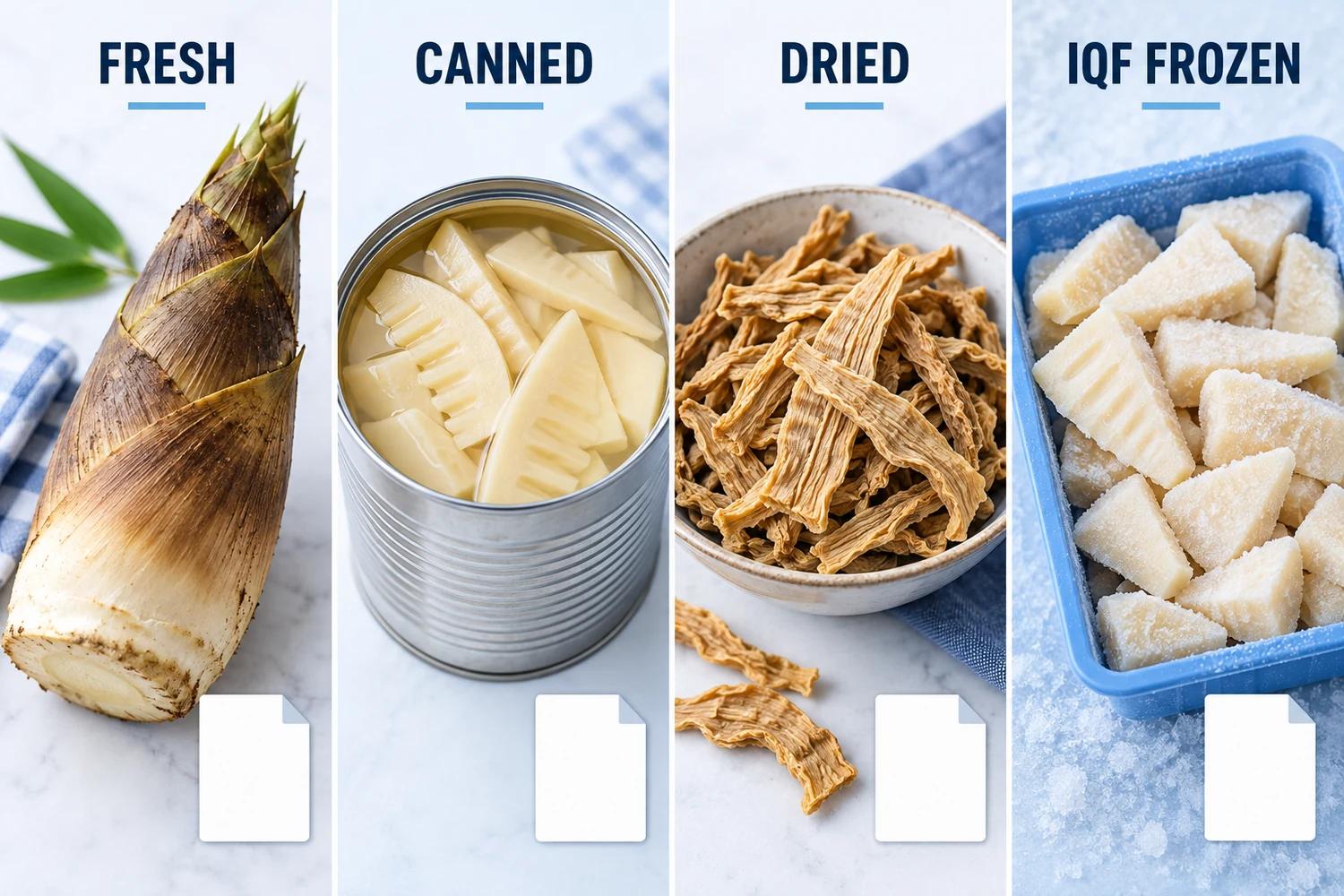
Illustration: fresh, canned, dried and frozen forms require their own label and treatment review.
Fresh, unprocessed shoots arrive with the most preparation still to do: identify an edible type, remove the sheath and fibrous base, cut the edible portion and cook it appropriately. “Fresh” on a market label can be ambiguous if a peeled or water-packed product has already been boiled. Check the supplier’s description rather than infer its status from the clear pack.
Commercially canned or shelf-stable packed shoots have undergone a different manufacturing route. They may be sold as slices, strips or tips in liquid. Read the label for ingredients, storage after opening and intended use. A dried shoot must be rehydrated and prepared according to its own instructions. Fermented or seasoned shoots bring a stronger taste and a different specification; they are not a direct replacement when a recipe expects a mild frozen vegetable.
IQF frozen bamboo shoots are cut pieces held frozen, often offered as strips, slices, dice or tips. The term IQF describes separation during freezing. It tells you little by itself about species, prior boiling or blanching, cooking completion, additives or ready-to-eat status. A frozen ingredient may fit a high-volume kitchen because the cut and pack can be selected in advance, but its processing status still has to be documented for the specific product. The XMG frozen bamboo-shoot product page lists its current cut directions and the specification questions to settle for an order.
Fresh bamboo shoots need a preparation step
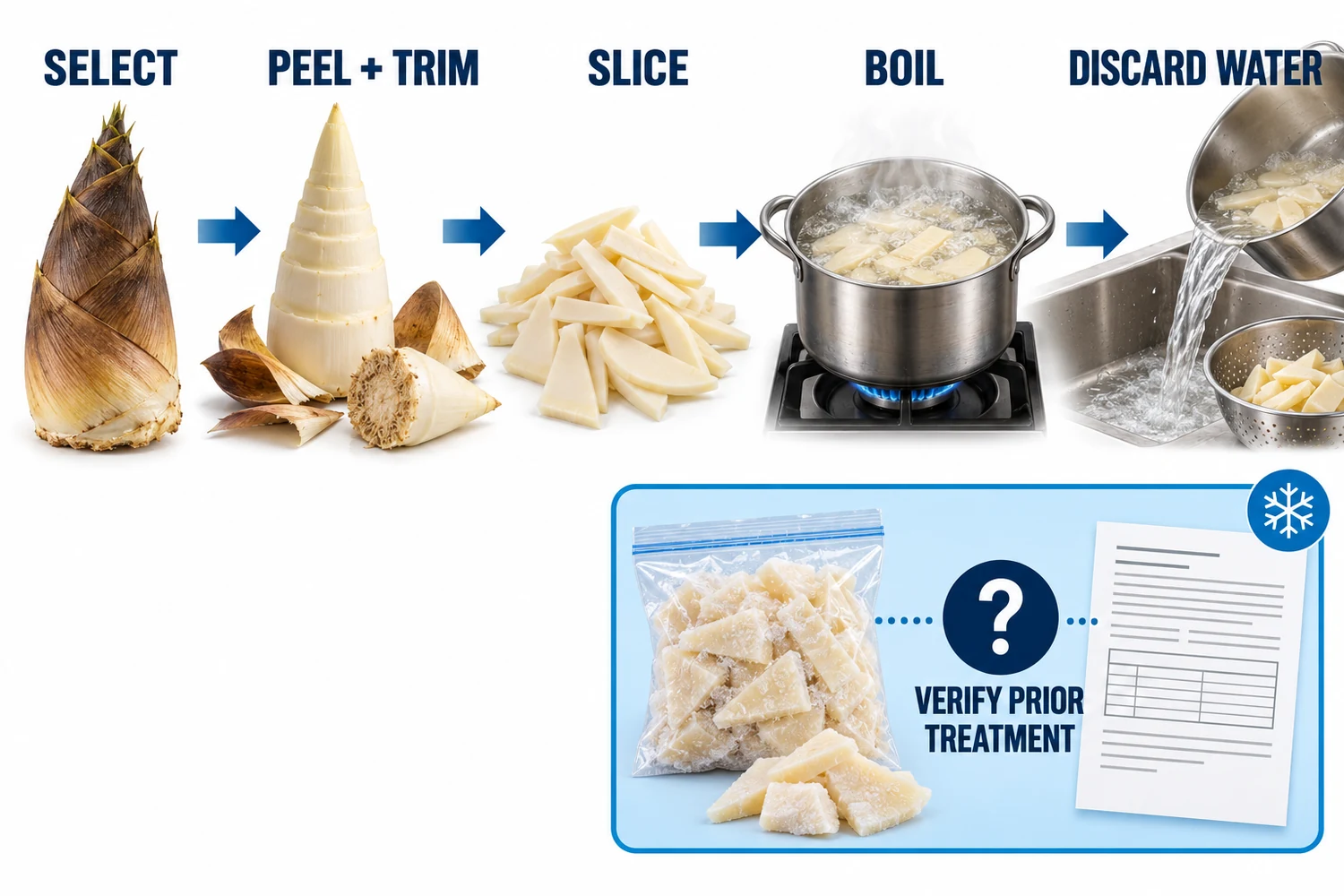
Illustration: prepare fresh shoots according to applicable directions; verify prior treatment for a frozen pack separately.
Unprocessed fresh bamboo shoots should not be eaten raw. They can contain cyanogenic glycosides, which may release hydrogen cyanide. [2] advises cutting a fresh shoot lengthwise, peeling away the outer leaves, trimming fibrous tissue, slicing the edible part thinly, boiling it in lightly salted water and discarding that water. Its published eight-to-ten-minute boil is an example for the described preparation, not a universal release rule for every species, cut size or commercial line.
The Hong Kong Centre for Food Safety’s assessment [3] found different cyanide amounts in different sources and shoot portions. In its samples, slicing and boiling reduced the measured amount substantially. The report also warns that variation may require longer treatment for some material. This is why a taste, pale colour, tender bite or freezer temperature should never be used as proof that an unknown fresh shoot is safe. Follow the applicable preparation guidance and product instructions; a commercial processor should control and document the relevant process for the material it sells.
Do not use water from the fresh-shoot preparation boil as a stock or sauce base. The handling of a prepared canned or frozen product may differ, so read its own directions rather than repeating a fresh-shoot recipe automatically. If the package or supplier cannot state whether the shoot was raw, blanched, fully cooked or otherwise treated, resolve that question before planning a no-cook or lightly heated use.
What frozen means and what it does not

Real product photo: the cut and visible variation can be inspected, while treatment status requires records.
Freezing extends the usable supply window and keeps a specified cut available for later cooking. It is a preservation method. It does not replace the processing required for an unprepared fresh shoot. For a commercial frozen offer, ask what happened before freezing: edible type selection, peeling and trimming, cutting, water or steam treatment, cooling, packing and the intended final cooking step. Request the actual product’s cooking directions and any treatment evidence relevant to the destination market.
The XMG product page describes an IQF supply route and a typical blanched-product specification. That is useful starting information, but the signed order specification and product records control the actual offer. A blanching or enzyme-activity check should not be treated as a declaration that cyanogenic compounds were controlled to a named limit or that the frozen product is ready to eat. Those are separate questions for the supplier and buyer to settle in writing where relevant.
The real cut-slice photograph on this page illustrates what a bamboo-shoot form can look like. It cannot show how that product was cooked, whether a particular lot meets a chemical specification or how it will behave in a finished meal. Keep visible appearance, documented treatment and a cooked product trial as three different pieces of evidence.
Choose the frozen cut for the dish

A second real product view shows narrower strips as a cut option for a cooked-dish trial.
Long strips can remain visible in stir-fries, noodles and spring-roll fillings. They need enough length to show after mixing, yet the piece must not become stringy after the final cook. A flat slice may be a better choice for hotpot, soups or a prepared dish where the ingredient should be recognisable in a spoonful. Dice can distribute more evenly through dumpling filling or a soup base, but small pieces may disappear visually. Tips are a presentation-led direction and require their own availability and size confirmation.
These are use cases rather than fixed grades. Before selecting a cut, decide whether the ingredient must be visible, how much chewing resistance is acceptable, whether it will be stirred heavily, and whether it will be cooked twice. Compare the offered cut in the actual sauce, broth or filling. A successful straight-from-pan bite may become less distinct after a closed hold or reheat. Keep the pack instructions and the operation’s food-safety method separate from your texture judgement.
For a frozen buying brief, record the species or commercial type if specified, cut name and dimensions, allowed off-size pieces, fibre or tenderness expectation, colour, surface ice, broken pieces and pack format. The XMG bamboo-shoot product page gives public examples for strips, slices, dice and tips; it says the signed specification defines the final limits. Do not copy a size from a website into a purchase order without confirming that it is available for the intended product and quantity.
Test an offered sample in the intended dish
Start with a named sample and its preparation information. Choose one finished food and write a short acceptance description: visible shape, acceptable fibre, flavour, and how the piece should hold after the planned cook and service. Follow the supplied cooking instructions. Use a consistent product mass, cut, recipe, equipment load and observation point when comparing candidates. If the first trial is too fibrous, record whether the persistent strands came from the offered part, cut or cooking route before requesting a different form.
Record the incoming frozen condition separately from the finished result. Check separation, loose ice and pack integrity at receipt. During the cook, note breakage, water release, bite and any flavour from the surrounding sauce. Recheck after the actual holding or reheating stage. Keep lot identity and the supplier’s treatment description with the trial record so that a later order is compared on the same basis. The specialist XMG cooked-sample review explains how to distinguish first-bite firmness from persistent fibres.
If the finished use involves little or no cooking after thawing, do not infer that an IQF pack is suitable from appearance or from this article. Ask for an explicit intended-use classification, process documentation and a product-specific instruction that supports the use. If those records are unavailable, design the dish around a documented cooking step or select a product whose intended use is stated clearly.
Questions cooks and buyers still ask
Are bamboo shoots the same as mature bamboo stalks?
No. The food is the young edible shoot of a suitable species, with the tough sheath and fibrous parts removed. A mature woody pole is a different plant stage.
Can I eat fresh bamboo shoots raw?
No. Unprocessed fresh shoots can contain cyanogenic glycosides. Identify a suitable edible type and follow appropriate peeling, cutting, boiling and water-discard guidance for the material and market.
Does freezing make bamboo shoots ready to eat?
No. Freezing is preservation. Confirm the pack’s prior treatment, intended use and cooking directions; do not infer cooking completion from an IQF label.
Which frozen cut works for a stir-fry or soup?
Strips are a useful starting point for a visible stir-fry or filling, while slices or dice may fit a soup depending on desired appearance. Compare offered cuts in the actual recipe and service route.
Does “blanched” mean the same as “fully cooked”?
No. The words describe different levels or purposes of heat treatment. Ask the supplier to define the actual process and intended preparation for the named frozen product rather than treating a blanching or enzyme result as a ready-to-eat declaration.
Explore frozen bamboo-shoot options or return to Food Knowledge for more ingredient guidance.
Discuss a frozen bamboo-shoot form with XMG
Tell us the finished dish, target strip, slice, dice or tip cut, and size and bite needed. Add the pack, volume, destination, desired treatment documentation and final cooking route. We can check the current IQF frozen bamboo-shoot offer and discuss a relevant sample, written specification and preparation status through our supply partners. Your team can then test that named sample in its intended cooked dish.
Frozen Bamboo Shoots
Review our frozen bamboo shoots range, product forms and specification options.
View Frozen Bamboo Shoots →