


On this page
For a prepared meal, choose between canned and frozen vegetables by comparing accepted finished portions, not by declaring one format better in general. Use the same meal target and serving point, define what each quoted product contributes after draining or preparation, then assess the actual dish for piece identity, texture, liquid, flavour and portion consistency. Count only portions that meet the project’s approval criteria when you compare costs. A low purchase price means little if the vegetable disappears in the sauce or the yield basis was measured differently.
Both formats can be sensible. A shelf-stable canned input may simplify storage and suit a soft, blended or long-cooked dish. An IQF input may give you more control over separate pieces, seasoning and partial-pack use. Those are reasons to select trial candidates, not predictions of the result. The vegetable species, cut, canning medium, frozen preparation, pack and meal process will decide what the team actually sees at service. We would put those details on the trial sheet before cooking either candidate.
Start with the meal, not the format

An incoming frozen mixed-vegetable sample shows the visible cut and blend. Its appearance does not establish performance after cooking or holding.
Describe the prepared meal as the buyer will sell and serve it. Is it a chilled tray that will be reheated, a frozen entrée assembled with raw or partly cooked components, a soup held hot, or a shelf-stable retort meal? The useful vegetable target changes with the route. A visible pea in a rice bowl needs a different approval standard from carrot that is meant to soften into a sauce. Write down the intended piece size, colour contribution, bite, seasoning role and typical number of pieces per finished portion.
Choose a vegetable or blend that can reasonably serve that role in both formats. “Vegetables” is too broad a trial unit. Frozen broccoli florets and canned diced carrots answer different menu questions. Even the same species can arrive in cuts that produce different outcomes. If you cannot find a closely matched canned and frozen cut, say that the trial compares the actual offered products, not preservation methods in isolation. That distinction protects the conclusion from becoming a false general rule.
Before sampling, identify the meal’s fixed conditions: recipe base, target filled weight, batch equipment, pack, holding route and point of eating. Set the attributes that can fail the project, such as a minimum visible-piece presence or an acceptable amount of vegetable liquid in the sauce. Do not invent an industry-wide tolerance. The developer should choose thresholds from the product brief and then apply them to both candidates.
Also decide which trade-offs are permitted. A buyer may accept a softer vegetable in a purée if colour and cost work well, but reject it in a premium meal where the menu promises distinct pieces. A canned product may be chosen for storage reasons even if an IQF version has a different bite. That is a legitimate project decision when it is explicit; it is not evidence that either format always performs that way.
Build a fair paired meal trial

Illustration: two actual quoted candidates should be assessed in the same intended meal and at the same service point; no result is shown.
Use a paired trial with separate, traceable candidates. Label each sample by supplier, exact product, vegetable species, cut, pack, batch or lot identifier if supplied, and stated preparation. Keep both samples under their required storage conditions. Then make the same base meal in appropriately sized test batches. Use each product according to its instructions and the processor’s approved food-safety controls. “Same recipe” does not mean forcing canned and frozen vegetables through an identical time or thaw step when their incoming states differ.
Record the condition when the vegetable enters the recipe. Is the canned product drained, rinsed or added with its packing liquid? Is the IQF product added from frozen, separately heated or thawed for this particular process? If the liquid stays in one meal but not the other, that is a formulation difference, not merely a format difference. Either align the intended liquid contribution or record it as a deliberate variable.
The USDA AMS product-specification library [1] keeps canned and frozen vegetables in separate commodity specifications. Those federal purchase documents do not govern every commercial order, but they make a useful point: a format label is not a full description of what arrives. A buyer’s sheet should state the actual quoted product and the relevant cut, liquid, pack and handling basis for each arm of the comparison.
| Trial field | Frozen candidate | Canned candidate | Keep comparable or record the difference |
|---|---|---|---|
| Product identity | Species, blend, cut and stated preparation | Species, blend, cut and packing medium | Match the intended vegetable role; do not call unlike cuts a format-only test. |
| Incoming measure | Frozen product received and portion withdrawn | Can net weight, drained solids and liquid decision | State which mass enters the recipe and which liquid is retained. |
| Meal formulation | Base recipe and other ingredients | Same base recipe and other ingredients | Record necessary format-specific adjustments rather than hiding them. |
| Processing route | Actual approved assembly, cook, hold and reheat path | Actual approved assembly, cook, hold and reheat path | Assess both at the product’s intended point of eating. |
| Acceptance | Piece identity, bite, colour, liquid and portions passed | The same named criteria | Use the project’s criteria, not a generic “fresh-like” score. |
For a large commercial decision, repeat the comparison with more than a single attractive sample. The number of lots, batches and portions depends on the variability and risk of the project; no universal number is justified here. Record exactly what was tested so the conclusion has a defined scope. One tray from one sample cannot support a claim about every supplier or every season.
Measure what actually enters the meal

Illustration: record canned drained solids and the frozen amount actually used. The blank scales intentionally show no yield result.
This is where apparent price advantages often change. A can’s net weight may include packing liquid that the kitchen discards. A frozen pack may contain edible pieces but may also produce liquid during cooking or have clumps and fragments that matter to the dish. Neither statement gives a universal yield percentage. Weigh what you actually use and state the measurement point.
For the canned candidate, record unopened net weight, drained vegetable weight under a consistent draining method, and whether any liquid goes into the recipe. For the IQF candidate, record the mass removed from the frozen pack, any separation or trimming loss, and the mass after the intended preparation if that stage matters. If a finished soup intentionally keeps released liquid, treating all of that liquid as “waste” would distort the comparison. If a stir-fry drains off excess liquid, ignoring it could distort the comparison in the other direction.
The USDA Food Buying Guide [2] describes its yields as planning averages and explains that an operation can conduct its own yield study when its actual results differ. It even gives a cut-green-bean example comparing purchase cost per serving across fresh, canned and frozen forms. Its school-meal documentation rules apply to that programme; the general commercial lesson is to keep the yield basis and serving size visible. We would measure the exact quoted candidates rather than copy a public average into a supplier decision.
Make a simple mass balance for each arm: purchased quantity, product entering the recipe, finished vegetable-bearing meal mass and accepted served portions. Retain the raw observations. If a can’s liquid is used as part of the sauce, note that explicitly; if an IQF blend contributes extra moisture that requires a process adjustment, note that too. This record helps the team understand whether a cost difference comes from ingredient price, usable solids, recipe yield or quality rejection.
Apply the comparison to water chestnuts
With water chestnuts, compare the actual cuts and preparations on offer, not just the words frozen and canned. An IQF offer may be whole, sliced, diced or cut into strips; a canned offer may use a different cut and packing liquid. Record each product’s ingredient declaration, piece size, preparation directions and intended point of addition to the meal. A cut difference may matter as much as the preservation format when pieces have to remain visible in a filling, stir-fry or tray meal.
Apply the mass basis above to these exact packs: record the canned net and drained weights, whether the liquid enters the recipe, and the IQF quantity used after any specified separation or draining step. Then judge the water-chestnut pieces in the finished portion at the intended service point. Note whether the cut remains recognisable and whether its bite fits the dish; if the meal will be reheated, assess it after that route. Our water-chestnut reheating trial guide sets out the product-specific observations.
A study of Chinese water chestnuts during canning found that texture measures changed differently across processing stages. It did not compare today’s IQF and canned offers in your recipe. Approve the format from the products and finished meal you actually test, with the cut, pack and processing route recorded.
Check cut and portion distribution
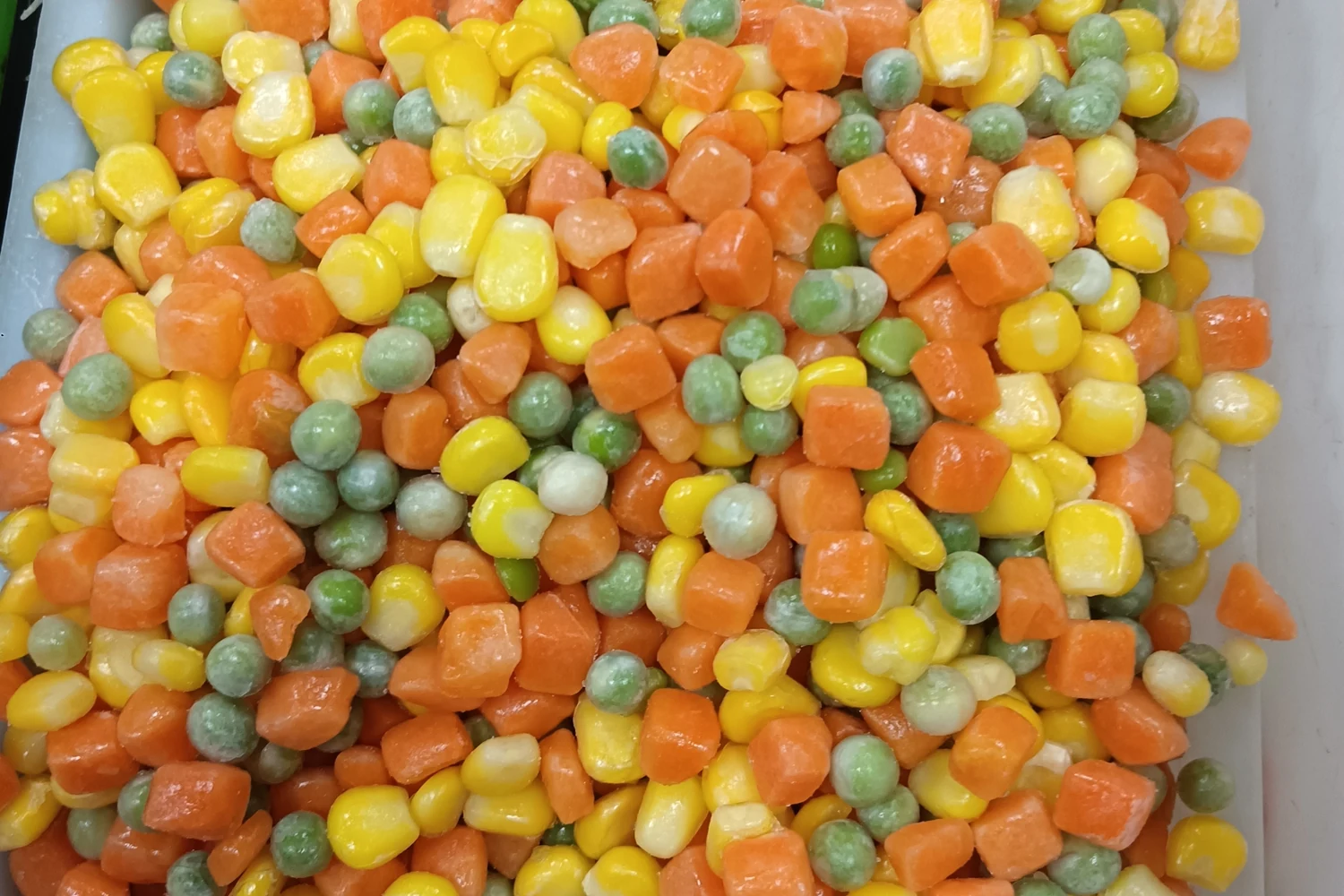
A second original frozen blend view makes the incoming piece shapes visible. A finished portion still needs its own distribution check.
Incoming appearance deserves inspection but has a limited job. Spread a representative amount of the frozen product on a tray so you can see cut size, separate pieces, fragments and mix distribution. Do the same with drained canned solids if they will be used that way. A supplier photograph may help identify the offered form; it cannot show what will be in every finished portion after mixing, cooking and holding.
For a mixed-vegetable meal, count or visually record how carrot, pea, corn and any other components appear in several portions. A blend can be technically within its ingredient list yet leave one portion with most of the colour or one component. A large floret or long bean segment may be easy to see but difficult to distribute at the target fill weight. These are reasons to write a cut and blend specification after trial, not reasons to favour frozen or canned automatically.
Colour should be judged under the same finished-meal lighting and sauce conditions. An IQF vegetable may enter with a bright surface and lose appeal after a long heat or hold. A canned vegetable may start with a softer colour yet look suitable in a dark sauce. The raw sample photo is an input-state record. Decide at the point the customer will see the food.
If the dish name or label promises a specific vegetable, piece identity can become a hard acceptance criterion. If the vegetable is present mainly to add body to a purée, exact piece edges may be irrelevant. Write those priorities before looking at the results so a visually attractive sample does not displace the actual product brief.
Judge quality at the right point
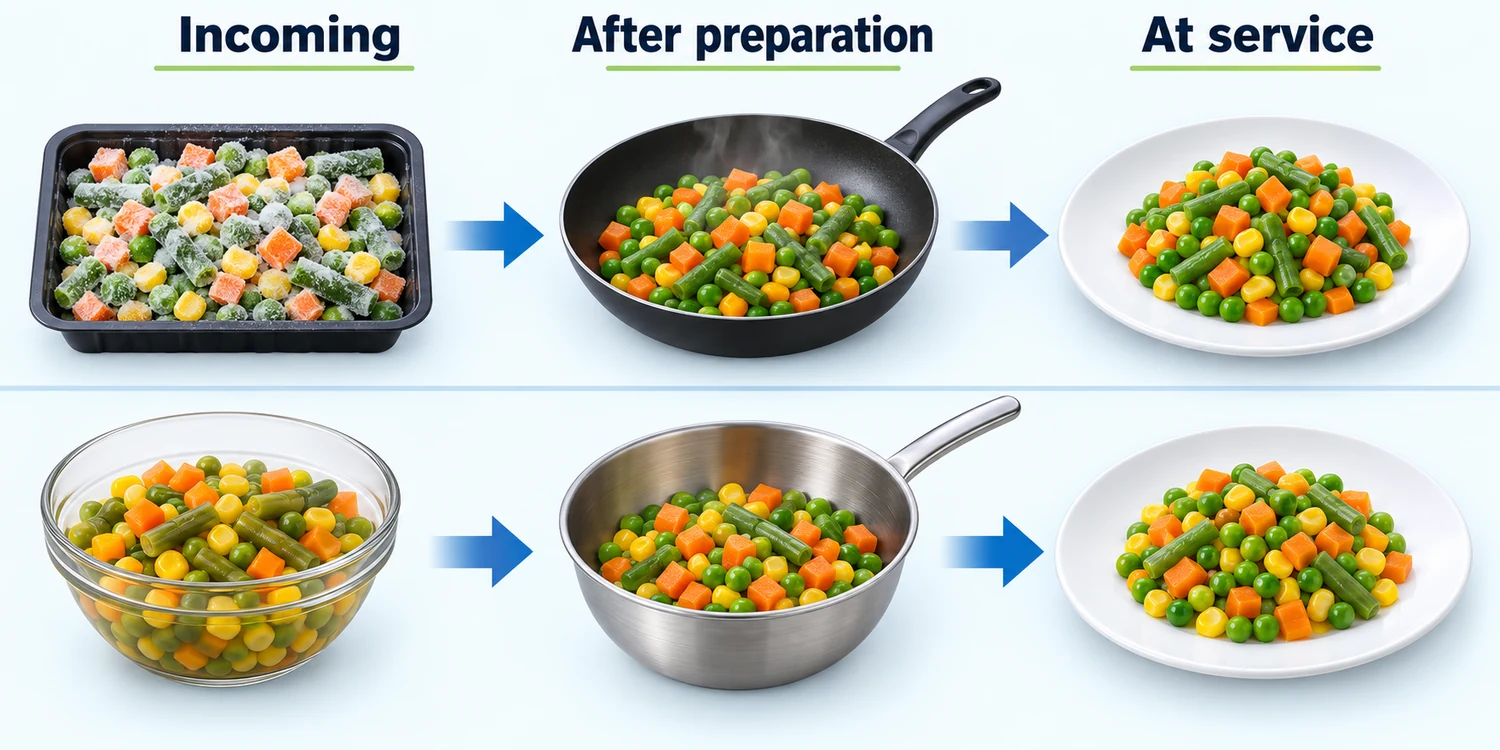
Illustration: keep the two candidate paths separate, then compare the finished portions at the intended point of eating.
Assess at more than one stage if it helps diagnose a problem, but make the final decision at service. Look at the incoming sample, the assembled meal, the meal after the production cook or pack, and the portion prepared as the customer will eat it. Keep observations by vegetable component rather than hide everything in one overall score. A tray could pass on colour while failing because one cut breaks down into the sauce.
Use plain, shared sensory descriptions. Does a piece remain identifiable? Does it have the desired bite for this meal? Is there unwanted free liquid or a seasoning shift? Does the vegetable compete with or support the intended sauce? A comparison panel should taste the two candidates at the same serving temperature and after the same defined service route, even when their earlier preparation differs. It may also help to conceal the format name during tasting, if the project wants to reduce expectations about canned or frozen foods.
Retort meals need a special boundary. Our guide to frozen vegetables in retort meal texture trials addresses ingredient history, meal assessment and the qualified processor’s thermal-process authority. Changing a vegetable, cut, pack or formulation to improve texture can affect the established process and may require expert review. This article’s format comparison does not set a safe retort schedule or override the processor’s validated controls.
The same caution applies to ordinary frozen meals: a photograph of an IQF product, or the word “blanched,” does not prove that the ingredient is ready to eat. The FDA guidance on ready-to-cook foods [3] explains that freezing preserves food but does not make unsafe food safe. Follow the supplied product instructions and the processor’s approved process when conducting any trial.
Compare cost only after quality approval

Illustration: purchase and handling costs should be related to portions that meet the project brief. The trays are symbolic, not a measured result.
Cost should follow the same unit as the decision: a finished portion that meets the project’s vegetable criteria. Start with the quoted purchase cost for the actual pack and order size. Add format-specific handling the operation really bears, such as freezer capacity and cold-chain movement for frozen goods, or can opening, draining and disposal for canned goods. Use the same accounting period and allocation basis for both. Do not insert a generic “cold storage surcharge” or assume can handling is free.
Then divide the relevant total by the number of accepted portions at the defined serving size. A candidate that produces fewer acceptable portions may cost more per approved meal even if its input price is lower. Conversely, the shelf-stable candidate can still win where its quality meets the target and frozen storage is costly. The result belongs to the tested products and operation. It should not be used as a category-wide price claim.
Keep ingredient cost and wider operating cost visible as separate lines. A production manager may need to know whether a cost difference comes from raw product, storage, labour, liquid management, line speed or rejection. If the trial is too small to estimate line behaviour, mark that field as pending rather than invent a saving. A useful first decision can say, “quality passed for both; commercial run needed to confirm handling cost.”
Price comparisons should also respect nutrition and ingredient claims when those matter to the product. Do not assume all canned vegetables contain added salt or that all plain frozen products are additive-free. Check the actual labels and specifications. If a customer requires a sodium target, a certain seasoning system or a nutrition statement, compare those facts for the quoted products separately from texture and cost.
Set an approval decision and next sample brief
Finish with an explicit record for each candidate: passed, failed or needs another trial. Name the tested vegetable, form, lot if known, recipe, processing route, service point, acceptance criteria and unresolved questions. A short matrix can show which candidate met visible-piece, texture, liquid, flavour and cost targets. Preserve the observations behind the conclusion so procurement can translate them into a repeatable specification.
If the frozen candidate wins, the next brief should define species or blend, cut range, acceptable broken pieces, packing, receiving condition and the exact meal use. If the canned candidate wins, the buyer needs its corresponding can size, packing medium, drained-solids basis and storage/handling plan. If both pass, the commercial choice may turn on production capacity, price, service reliability or a customer’s format preference. The trial does not need a dramatic winner to be useful.
For a stir-fry built around one specific item, our frozen versus canned baby-corn guide addresses that narrower dish and cut. Use the general record here to compare meal inputs; use the specialist guide when baby corn itself is the named problem.
Questions buyers still ask
Are frozen vegetables always firmer than canned vegetables in prepared meals?
No universal result follows from the format alone. The vegetable, cut, prior processing and finished-meal cook or hold all matter. Compare the quoted candidates at the intended point of eating, using the meal’s own texture target.
Should I compare can net weight with frozen pack weight?
Not as a direct measure of edible meal input. Record the canned product’s drained solids and liquid decision, and the frozen quantity that actually enters the recipe. Then measure accepted portions at a defined serving size.
Can the same cook time be used for both candidates?
Do not force identical handling when the incoming products have different preparations. Follow each product’s instructions and the processor’s approved controls, hold the target meal and service point steady, and record the format-specific steps.
Does XMG supply both canned and frozen vegetables for this trial?
Our current offer discussed here is IQF frozen vegetables. The canned arm must be sourced and specified separately. We can help confirm an available frozen form and sample basis for a buyer-controlled comparison.
Explore the frozen vegetable range or return to Buyer Guides for other purchasing comparisons.
References and related reading
- USDA Food Buying Guide: yields and cost-per-serving basis [2]
- USDA AMS: separate canned and frozen vegetable specifications [1]
- FDA: ready-to-cook food safety guidance [3]
- XMG Food: frozen vegetables for retort meal texture trials
- XMG Food: frozen versus canned baby corn for stir-fries
- XMG Food: frozen vegetable range
Discuss the frozen candidate with XMG
We can discuss available IQF vegetables and mixed-vegetable forms for the frozen arm of your prepared-meal trial. Send the meal application, vegetable role and preferred cut or blend, along with pack, quantity and destination. We can confirm which frozen product specifications and sample options are available for that enquiry. We are not offering the canned comparison product through this request.
After a trial, tell us which cut remained visible, where liquid or breakage mattered, and which portion criteria the frozen candidate did or did not meet. That gives us a basis to discuss an available alternative form or a tighter order specification.
Frozen Vegetables
Browse our vegetable range and compare product forms, specifications and packing options.
Explore Frozen Vegetables →