


On this page
Yardlong beans are not simply extra-long green beans. The yardlong or asparagus bean is a type of Vigna unguiculata; the familiar common snap green bean is Phaseolus vulgaris. That distinction is useful for identifying an ingredient, but it does not tell a prepared-meal team which frozen product will taste better in its recipe. Pod maturity, cut length, pre-freezing treatment and the meal’s cooking, holding and reheating sequence decide whether one can replace the other.
Start with the finished dish. If the bean is a visible strand in a stir-fry, shape and bite matter. If it is a short cut inside a sauced rice tray, portioning, fibre and liquid release may matter more than original pod length. Compare representative frozen samples in the same recipe, then give each candidate a fair process adjustment before choosing. A botanical label alone cannot approve a substitution.

Conceptual illustration: pod shapes help identify the two bean groups, but do not predict a frozen lot’s cooked bite.
Recognize two different beans
Yardlong beans are also sold as asparagus beans, Chinese long beans or long-podded cowpeas. Common green beans are often sold as snap beans or string beans. These names overlap in everyday buying conversations, so put the botanical name and commercial product description on the sample request. [1]. It is a useful identity check, not a promise about how any processed lot will cook.
The typical yardlong pod is long and slender, whereas a common snap bean is shorter and often plumper. A frozen meal manufacturer rarely buys those whole fresh pods in the exact form pictured in a garden guide. Both may be cut, graded, blanched and frozen. Once cut, a long pod can look surprisingly like a shorter one in a tray. Ask for the declared species, cut form and photographs of the offered frozen product rather than approving a carton from the retail name alone.
It is tempting to describe one species as universally more tender or more flavorful. That skips the most important variable: where the pod was in its development when harvested. Young pods of either type can give a different bite from older pods with enlarged seeds. Cultivar, cut, process and final cooking add further variation. Use species to prevent a mistaken identity; use a cooked trial to establish suitability.
Check maturity before you blame the species
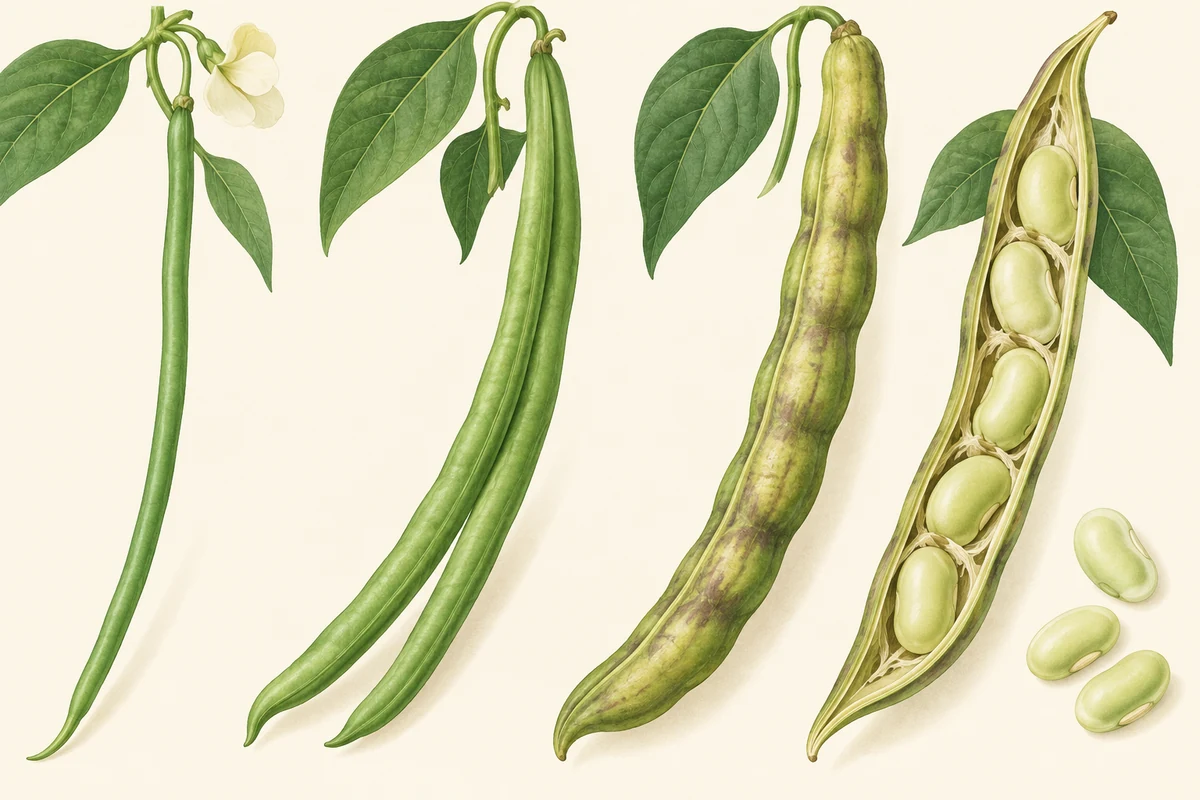
Conceptual illustration: an enlarged seed and pod wall prompt a sample inspection; this is not an acceptance threshold.
A pod that has become swollen around its seeds may be a poor match for a dish designed around a smooth, tender piece. [2] describes harvesting yardlong pods for snap-bean use before the seeds expand or plump. That fresh-harvest observation gives buyers a sensible inspection question, but it does not define an automatic numerical acceptance limit for every frozen grade. Decide what the finished dish can tolerate, then write a sample-based limit for that order.
Inspect a representative spread of pieces, not just a handful from the top of a pack. Photograph smooth pieces and any noticeable seed bulges beside a ruler or another scale. Cut a few suspect pieces across the pod wall and note whether the seed is prominent. Cook and taste them in the intended application. A visible bulge does not by itself quantify fibre or rejection rate, and a uniformly green surface does not guarantee a tender bite after reheating.
Record the observation in language a supplier and receiving team can repeat: “no conspicuous seed bulges in the approved sample,” or “exclude pieces with a stringy bite after the stated heat cycle.” If the purchase is large, agree how many packs and pieces will be inspected and how deviations are handled. Those numbers must come from a jointly approved product specification, not an arbitrary threshold taken from a garden article. A photograph with the lot or sample ID is more useful than an unsupported adjective such as premium.
Compare the frozen form, not the original pod length

Conceptual illustration: compare the offered cut distribution and fines rather than assuming pod length survives processing.
For a prepared meal, the product form is often the first operational difference the kitchen sees. Ask whether each candidate is whole, cut to a stated length range or supplied as a mix of pieces. Check for broken ends, fines, clumps and surface ice. Record whether the beans were blanched before freezing, and obtain the supplier’s preparation instructions. A yardlong bean cut into short pieces will not create a long-strand appearance, while a common green bean cut long enough may work visually in a different recipe.
Put both samples on the same tray with a scale and photograph them before cooking. Count or weigh pieces outside the intended cut range if length affects the plate. If the product is intended for automated filling, test whether pieces bridge the dispenser, tangle or settle unevenly in the sauce. The longest attractive piece in a sales photograph is less important than the distribution in the delivered pack. Where appearance is critical, distinguish the typical length from occasional extremes in the buying brief.
Processing history also changes the comparison. Blanching before freezing is a production step; it is not proof that a frozen bean is fully cooked for your meal. [3] explains the role of blanching in vegetable freezing, but home-preservation timings cannot be applied as a universal finished-meal cooking instruction for commercial frozen beans. Follow the offered product’s directions and the kitchen’s validated process. If the two candidates have different instructions, document that difference instead of forcing one set of assumptions onto both.
Choose the role the bean must play
A long bean may be chosen for visible strands in a stir-fry, a regional recipe identity, or a particular bend and bite alongside noodles. A common green bean may be preferred for a familiar short cut, clear portion distribution or the way it looks in a mixed vegetable tray. These are possible menu roles, not fixed properties of the species. State the role before tasting so a team does not change the success criterion after seeing the price or a preferred supplier.
Write one sentence about the guest-visible result: “distinct green pieces remain intact after reheating,” or “long, flexible strands are still recognizable in the sauce.” Then state the less visible requirements: no objectionable strings, acceptable seed prominence, manageable liquid release, consistent portion weight and no extra handling beyond the production line’s capacity. A restaurant dish eaten immediately and a chilled retail tray eaten after reheating need different evidence. The same frozen ingredient can satisfy one and fail the other.
When the menu names yardlong beans or Chinese long beans, changing to common green beans can also change the described ingredient. Check the recipe declaration and menu copy through your own regulatory and customer-approval process. Where the bean is an unnamed supporting vegetable, the decision may rest more on sensory and process equivalence. Do not infer that a botanical substitution is automatically acceptable merely because the color is similar.
Run a matched prepared-meal trial
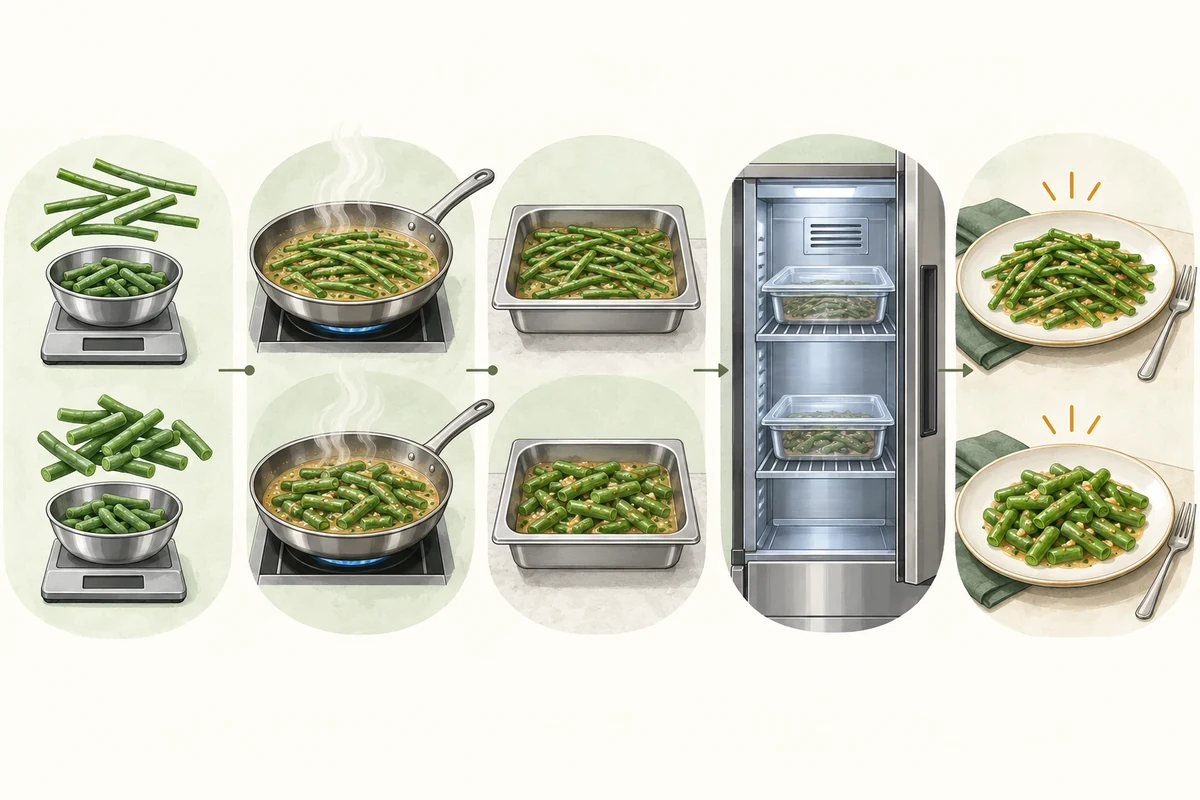
Conceptual trial plan: keep the recipe and service sequence comparable, then record any product-specific process adjustment.
Begin with the supplied frozen forms, not a fresh version of one and a frozen version of the other. Document sample ID, pack condition, cut distribution, pre-treatment declaration and storage history. Set the same recipe, sauce, salt, target serving mass, equipment, pan loading and intended service sequence for both. Record the starting temperature and whether the product enters the process frozen. Use the supplier’s instructions and your site’s food-safety controls for the actual cooking method; this guide does not prescribe a safe time or temperature.
A useful first run asks how each product behaves under the current process. That exposes practical questions: Does one piece soften earlier? Does a longer cut snag during filling? Does the sauce become more watery? Does the color dull after hot holding? Run enough portions to see routine variation, not just one carefully assembled plate. Keep the sauce and other ingredients constant and photograph both immediately after cooking under the same lighting.
Next, give each candidate the best reasonable process within your operation. One may need a different addition point or separate pre-cook; another may work in the existing kettle. Compare their best acceptable results as well as the extra labor, equipment and validation that each adjustment requires. Calling a bean “worse” after one identical heating duration would confuse product fit with process fit. Equally, a delicious result that needs an impractical separate step may be a poor choice for a high-volume tray line.
Hold a portion through the real service window, then chill and reheat another portion if that is how the finished meal will be sold. Use the exact sequence the product will experience, with the site’s documented controls. A frozen ingredient that tastes good from the pan can lose its intended bite after a second heat cycle. Keep the immediate, held and reheated observations distinct; a single overall preference score hides where a candidate failed.
For a production kitchen, include the least forgiving normal equipment setup in the test. A shallow development pan can heat and evaporate differently from a deep kettle or a fully loaded tray line. If vegetables are added at different points, record that choice and repeat it on a second batch; a one-off chef adjustment is not yet an operating procedure. A substitute must remain acceptable when routine staff follow a documented process, not only when a developer watches every portion. If a trial cannot represent the actual line, mark the conclusion as provisional and schedule a production-scale check before purchasing commitments.
Score the finished dish with observable criteria

Conceptual illustration: score the served portions for recognizable shape, bite and liquid rather than declaring a species winner.
Ask evaluators to score the dish, not to guess which bean “should” be superior. Separate visual shape from bite. Look for recognizable pieces, breakage, seed bulges, sauce coverage and whether the vegetable has spread evenly across the portion. Taste for tenderness, stringiness and any flavor that disrupts the recipe. Observe liquid at the bottom of a tray after reheating, but do not attribute all liquid to the bean without a control: sauce, other vegetables and packaging can contribute.
Use a short scorecard with descriptions and a pass/fail target that the team agrees before the tasting. For example, “most served pieces remain visibly intact” is a useful target only after you define how many portions to inspect and what “intact” means. Photograph a passing and failing portion. Let culinary development judge sensory fit, operations judge line handling, QA review the process and declared product, and procurement check whether the approved specification can be bought repeatedly. Those perspectives may legitimately disagree until a trial makes the trade-off visible.
| Decision point | Yardlong-bean candidate | Common green-bean candidate | Evidence to retain |
|---|---|---|---|
| Identity | Confirm Vigna unguiculata and named product form. | Confirm Phaseolus vulgaris and named product form. | Supplier description and sample IDs. |
| Incoming form | Measure cut distribution, bulges and broken pieces. | Measure the same against the intended cut. | Same-scale photographs and pack notes. |
| Cooked bite | Record tenderness, stringiness and seed perception. | Use the same descriptors after appropriate cooking. | Blind tasting notes where practical. |
| Meal process | Test filling, holding and reheating behavior. | Test the same route and any needed adjustment. | Process log and finished-tray photos. |
| Commercial decision | Cost the acceptable portion and any extra step. | Cost on the same basis. | Approved specification and quotation basis. |
The cells describe what to measure; they are not actual XMG lot results. The final answer may be one candidate, two approved candidates for different dishes, or a decision to change the recipe. Keep the failed observations as well as the successful photographs. They explain why a future substitute must be retested rather than silently swapped.
Translate the trial into a repeatable buying brief
Once the meal team has chosen a form, specify the species, cut range, handling state, intended use, acceptable seed prominence, visual breakage and the cooked sensory target. Attach representative photographs from the approved sample and identify the process used to produce the reference portion. Include the supplier’s cooking guidance in the approval file, but keep it separate from the site’s own validated recipe process. If the product form or production source changes, agree when a new sample and trial are needed.
Price should be compared on acceptable finished portions rather than carton mass alone. Record received mass, product lost to fines or unsuitable pieces, cooked mass, portions that meet the plate target and any extra labor or line time. Those measurements come from the trial; a generic yield percentage would hide the cut and recipe differences. If a longer pod produces a visually appealing dish but tangles during filling, include that process cost. If a shorter cut portions reliably yet becomes too soft after reheating, its lower pack cost may not solve the menu problem.
Keep the quotation comparison equally specific. Currency, delivery basis, pack size, minimum order, lead time and the nominated product form must all be visible next to the trial result. A lower price for a different cut or pack is not a clean substitute for the approved ingredient. Where a buyer needs continuity, ask whether the same specification can be sampled from an alternate supply route and decide in advance which differences trigger a new kitchen test. This avoids making a sensory decision in development and an unrelated commercial decision later under a nearly identical product name.
Our frozen asparagus-bean page provides the relevant product route. The XMG specifications and sampling process is where we can coordinate a representative form and record the agreed checks. We do not infer a specific cut, blanch state, volume or sensory result from a website photograph. Tell us the meal application, target piece length and bite, pack requirement, approximate order volume and destination; we can review the available product details against that brief.
When a substitution deserves a second trial
A previously approved bean is not a permanent approval for every later crop or product change. Retest when the offered cut range, maturity profile, origin, processing route or cooking instruction changes materially. Revisit the trial if the menu moves from immediate service to chilled retail, if the sauce becomes thicker, or if the production line’s hold time increases. Those changes can move the decision even when the species stays the same. Keep the sample identity and recipe version together so the next team knows what was actually approved.
For a mixed portfolio, it can be sensible to approve yardlong beans for a dish that depends on long visible strands and common green beans for a tray requiring short uniform pieces. That is a menu design decision supported by two separate trials, not a claim that one species is inherently premium. If a recipe can accept both, specify the conditions under which the buyer may switch and who signs off on the replacement. An alternate-source plan only works if both options have been tested in the process customers will experience.
The practical answer remains simple: verify the bean, inspect the frozen form, cook it in the intended meal, and judge it after the final heat cycle. Length can catch the eye in a product photo; finished bite and repeatability decide whether the ingredient belongs in a prepared meal.
Frozen Asparagus Beans
Review our frozen asparagus beans range, product forms and specification options.
View Frozen Asparagus Beans →