


On this page
A useful frozen porcini inspection does not reduce every dark mark or crunchy particle to one “defect” score. First confirm the declared product and lot. Then record insect galleries, identifiable insect material and mineral grit separately, using a sample and examination method that buyer and supplier can repeat. The purchase specification—not a threshold borrowed from a different mushroom product—must say what happens to each finding.

Product-form photo from our approved library. It shows whole pieces, not an inspected lot or evidence of defect absence.
Confirm the lot and declared cut before scoring defects
When a carton arrives, start with identity and scope. Record the supplier’s product name, declared species or species group, cut, grade, pack, lot code and production date. Photograph the outer carton and inner label before opening anything. A whole-cap pack, thick slice pack and small dice pack expose different amounts of internal tissue. Their visible defect rates cannot be compared fairly until the unit of inspection is defined. If the delivered form is different from the agreed form, hold that discrepancy apart from the insect or grit count.
Porcini is a commercial name that may be used across more than one bolete species. Our separate guide to verifying porcini and boletus names explains why the name on a quotation should be tied to a declared scientific identity and document set. This article assumes that identity question has been settled. A clean slice of the wrong declared species is still a specification issue; a correct species can still have grit or insect damage.
For a frozen inspection, also document receipt condition. Note carton integrity, obvious temperature abuse, heavy clumping and any thawed liquid before the sample is manipulated. Keep the product within the agreed temperature-control procedure and record when the carton was opened, when a portion was thawed for examination, and who handled it. Those steps protect the interpretation of the observation. A soft, wet piece examined after an uncontrolled bench hold is a poor comparator for a second frozen lot.
Our frozen boletus product page describes offered forms and current physical and sensory controls. It is a starting point for discussing a particular offer, not a certificate for the cartons in front of you. Confirm the applicable specification version and proposed acceptance terms for the grade being purchased.
Separate galleries, actual insect material and grit

Conceptual illustration: record tunnelling, identifiable insect material and mineral grit as separate observations.
An insect gallery is a channel or cavity through mushroom tissue. It may be empty when inspected. An intact or fragmentary larva is identifiable insect material. A dark inclusion might be soil, a natural tissue mark or something else; it should not be called mineral grit until it is examined. These are three different observations with different units, denominators and corrective actions. If the inspection sheet has only one “insect/grit” box, it is difficult to tell whether a supplier changed raw-material sorting, cleaning or both.
The FDA Macroanalytical Procedures Manual, V-11 [1] is useful for understanding the distinction between tunnelling damage and insect material in mushroom examination. Its mushroom method discusses common cultivated mushrooms and other specified products; it does not establish a general frozen-porcini acceptance limit. We use the vocabulary to build a reproducible buyer record, not to claim that its test procedure or defect number automatically governs this product.
Define a gallery before the inspectors see the lot. For example, agree whether superficial pinholes, discoloured but intact tissue, and a clear internal channel are counted separately. Note whether a whole piece is scored once if several galleries occur in it, or whether each gallery is counted. Define what qualifies as identifiable insect material and how an uncertain particle is held for review. If the contract uses “insect infested,” make its observation rule explicit. A vague adjective gives two inspection teams room to reach opposite decisions on the same carton.
Grit needs its own description. Is the concern visible soil on an outer surface, hard mineral particles recovered from a defined rinse, or a sensory report from a finished dish? These are related but not interchangeable. A visual surface check may miss particles in folds and pores. A rinse recovery test can lose fine particles unless the water volume, mesh or filter and recovery steps are consistent. A bite test can identify a problem but is a poor quantitative acceptance method without a controlled preparation and trained panel.
Build a repeatable frozen sample
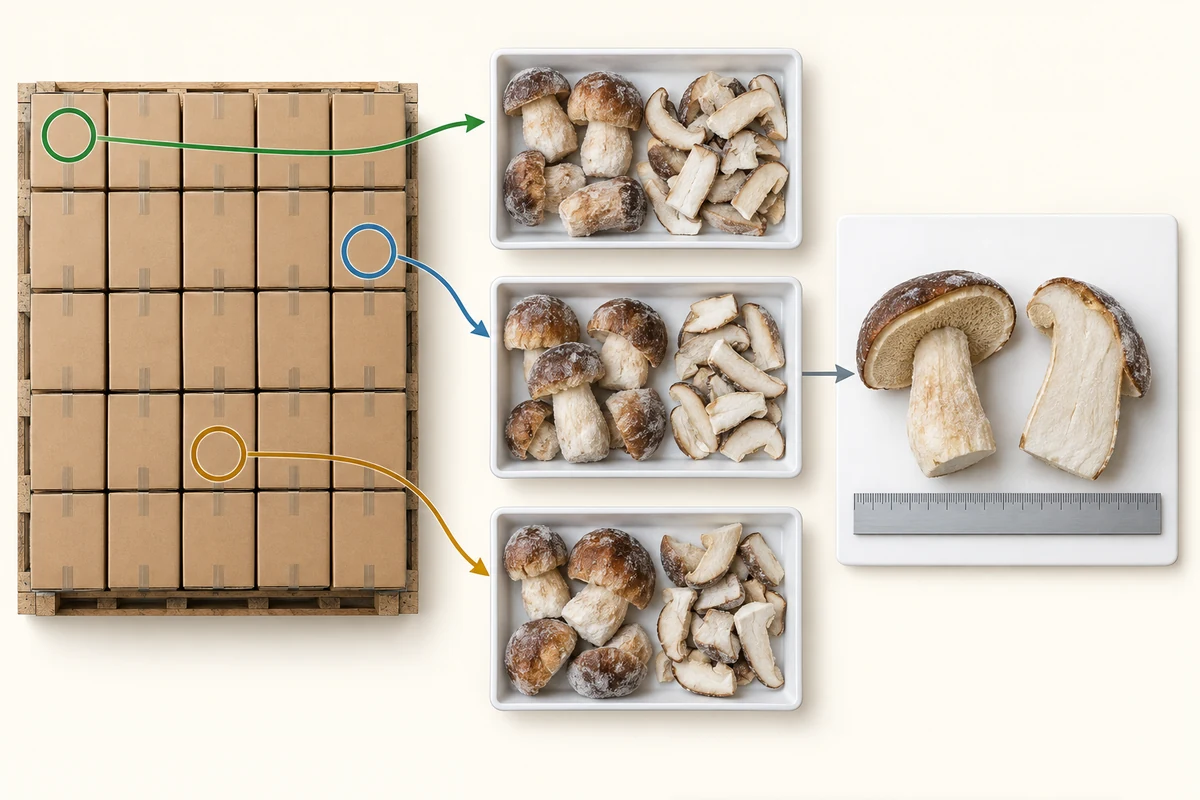
Conceptual workflow: agree carton selection and inspect both outer and cut surfaces; sample size remains contract-specific.
Agree the lot boundary before pulling cartons. A lot might be tied to one production run, raw-material intake, grade or packing date; do not quietly pool cartons from different codes and report one blended result. Specify how many cartons will be selected, where they will be chosen from the pallet, and whether sealed cartons or open cases are eligible. Pulling only the cleanest accessible carton cannot represent the full shipment. Record the random or systematic selection rule so another inspector can reproduce it.
Next, define the sample unit. A carton count alone is not enough. Will the denominator be examined mass, individual pieces, cut faces or a number of packages? A 10 kg whole-piece examination and a 10 kg fine-dice examination do not expose the same number of surfaces. State both the total mass and the number of pieces or sub-samples actually examined, where feasible. Separate the portion used for frozen visual inspection from the portion thawed for cutting or rinsing. Mark their containers with lot code, carton number and sample time.
The sample plan should also say what happens if the first check is borderline. A buyer may agree a second independently drawn sample, a joint inspection, or a hold pending laboratory or supplier review. Those options should be written before anyone knows the result. Otherwise the second sample can become an ad hoc search for a preferred answer. Keep untouched reference material under the agreed storage conditions if the shipment and method permit; document custody when portions go to another team.
Scale matters in photographs. Place an unobtrusive ruler or calibrated reference beside a suspected gallery or particle, and include one wider view that identifies the piece or tray. Photograph the label and sample number in a separate frame rather than covering the tissue with annotations. Save originals as well as annotated copies. A close-up without scale can make a tiny cavity look like extensive damage; a wide carton shot may hide the feature entirely.
Write the handling conditions into the inspection worksheet: examination temperature, partial or full thaw decision, lighting, magnification if used, water source for any rinse, and permitted time between opening and observation. This lets the supplier’s repeat inspection use the same conditions as the buyer’s first inspection. If the method cannot be repeated on a normal receiving dock, decide whether it belongs in a separate reference-lab procedure instead.
Open whole and thick pieces; keep external and internal findings apart

Product-form photo from our approved library. It illustrates a slice format; it does not document a grit or insect test.
Whole caps and stems can conceal channels. Inspect the outside first, then cut an agreed portion of the whole or thick pieces through the stem and cap. A single arbitrary cut is easy to miss a narrow gallery; the plan should state the cut pattern or number of faces, without assuming that every piece must be destroyed. Record external marks separately from internal cavities. A suspected channel should be photographed on a fresh face before it is scraped, washed or otherwise changed.
Look at the structure of the cavity. A continuous tunnel through tissue differs from a natural pore surface, breakage void or knife tear. An inspector may need to mark an uncertain feature as “suspect” and request a second trained reading. Do not convert every dark spot into an insect count. Equally, do not dismiss a clear channel because no insect remains in it. Keeping gallery and identifiable-material columns distinct preserves that nuance.
For slices or dice, describe how pieces are spread and inspected. Overlapping frozen slices hide faces. A fixed tray depth, defined viewing area and recorded mass help. Some pieces may be too small to classify reliably by gallery severity. If so, the grade specification should set an appropriate inspection unit or use a different method. Document the limitation instead of reporting a falsely precise percentage.
Our approved-library photographs in this guide show a whole and a sliced product form. They are not photographs of a failed lot, an insect finding or a grit result. The conceptual defect illustration shows what to look for, but it is not evidence that any XMG shipment contained those conditions. The distinction matters when a buyer sends an article image around internally: only a dated, scaled image tied to the sampled lot can support that lot’s disposition.
Test grit with an agreed recovery method
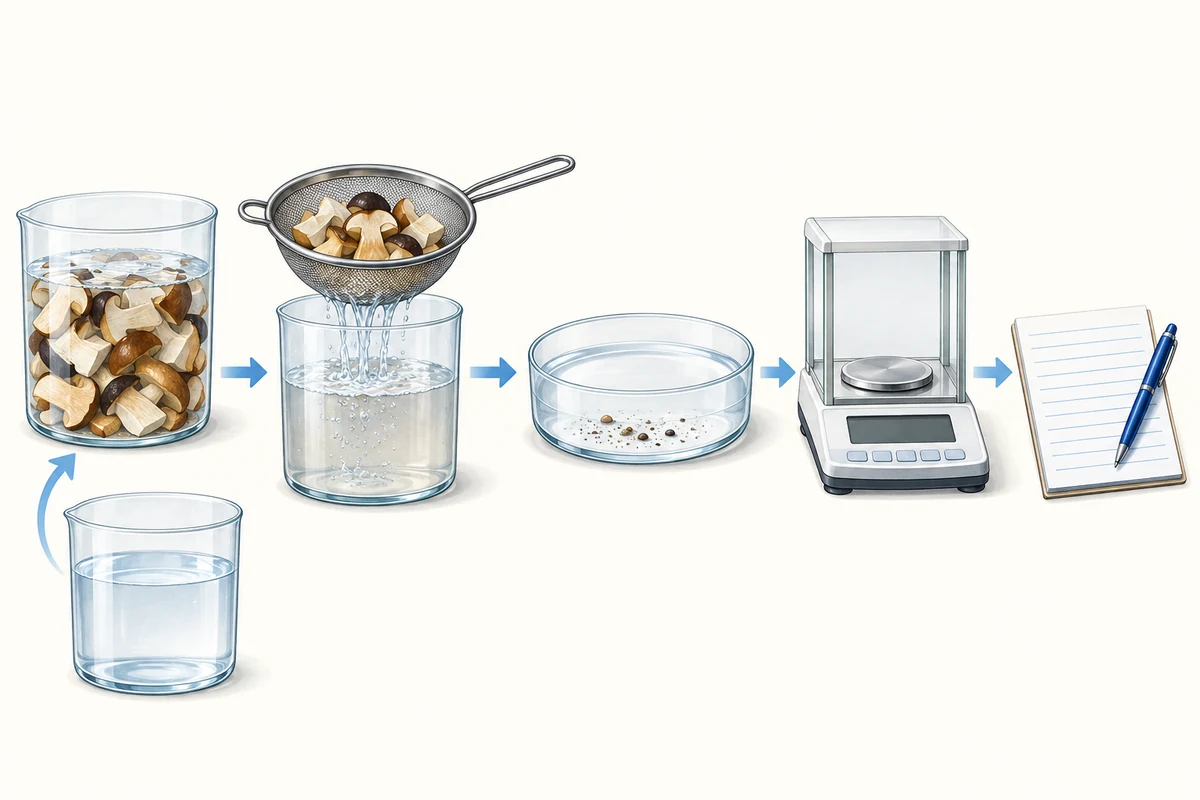
Conceptual workflow: a blank and defined recovery method make grit findings interpretable; no result is claimed.
Begin by deciding what “grit” means for the contract. Mineral material recovered after an agreed rinse is a defensible measurable endpoint. Visible soil, organic fragments and hard mineral particles should be separated if the result is meant to guide corrective action. State whether the result is reported as particles per sample, recovered dry mass per examined product mass, or a pass/fail observation under a named method. The numerical threshold, if any, belongs in the buyer specification.
A practical method outline is: weigh the defined sample; use a measured volume of clean water and a specified vessel; agitate or rinse in a stated manner; pass the wash through a chosen sieve or filter; allow fine material to settle if that is part of the method; examine and document the recovered material. Keep a water-and-equipment blank. If the blank leaves grit, the product result cannot be interpreted confidently. When a filter is dried and weighed, the drying and weighing method also needs to be recorded.
Do not improvise a recovery percentage. Very fine particles, mushroom fragments and water trapped in the filter can change the result. Trial the proposed method with repeat portions and, where appropriate, a known reference material so the teams understand whether it actually retrieves the material of concern. A method that works for whole pieces may not work for small dice, where more product fragments pass the screen. The filter mesh, water volume and agitation have to suit the offered cut.
Retain any suspect particles for review in a labelled container or on the filter, according to the agreed procedure. A photograph against a scale can help; a tiny dark fleck in cloudy rinse water is not enough to establish mineral identity. For a disputed result, an appropriate laboratory method may be more reliable than a dockside guess. The article’s illustration is a method concept, not a validated XMG lab result or a promise that one rinse removes every particle.
Cooking a sample may reveal a sensory grit problem, but the trial must be controlled if it is to support a buying decision. Record the recipe, product mass, any pre-rinse, sauce or carrier, preparation time and assessors. Keep a clean comparator when possible. A sensory complaint deserves investigation even when a small recovered-mass sample passes, because the sampling distribution may be uneven. Conversely, one surprising bite does not tell you the affected percentage of an entire production lot.
Record a finding the supplier can investigate
The report should contain the lot code, carton selection, product form, temperature/handling note, inspector, date, method version and exact amount examined. For each defect type, provide the agreed numerator and denominator. For example, state “pieces with confirmed galleries / pieces cut” separately from “pieces with identifiable insect material / pieces examined.” For grit, record the recovered endpoint and test blank. Add photographs with sample IDs, plus any preserved material. Include uncertainty rather than silently rounding it away.
Keep a separate line for severity and distribution. One large channel in a single piece, several small channels scattered across a number of pieces, and a concentrated cluster in one carton tell different stories. They can also suggest different corrective actions. Record the number of affected cartons as well as the total sample, rather than collapsing everything into one shipment-wide average. The buyer may need to decide whether sorting a bounded portion is possible or whether the lot definition itself must be reviewed.
Do not treat a guide as an automatic accept/reject authority. The FDA Compliance Policy Guide on mushroom insect defects [2] explicitly concerns canned and dried, freeze-dried or dehydrated mushrooms. Its figures are not a ready-made legal tolerance for frozen porcini. Applicable law, food-safety controls and the contract must be assessed for the market and product. A safety concern may call for a hold and escalation regardless of a commercial allowance.
One public XMG boletus product-page control describes zero mouldy, decayed or insect-infested units in a 10 kg inspection sample, alongside separate foreign-material controls. Use that statement only in its published product-page context. It is not a lot-specific result and does not define every possible gallery, visible insect or grit-recovery method for every grade and order. Before a purchase, we should confirm the exact offered product specification, inspection unit and disposition rule with the buyer.
The report should say what happens next: release, hold for joint review, inspect an agreed second sample, sort under an approved procedure, or reject under the contract. Name who can authorize each step and how long material remains on hold. If sorting is proposed, specify how the reworked material is identified and re-sampled. A corrective-action note without a defined retest can leave the same uncertainty in the next shipment.
Turn the inspection into a purchase specification
Ask the supplier for the declared species, cut and grade; the raw-material sorting stage; cleaning and grit-control steps; inspection method; lot definition; and a sample record for the actual offered product. Ask how their staff distinguish an empty gallery from insect material and how uncertain findings are adjudicated. Request an example report format, not an invented claim that a hypothetical lot passed. If they use a different method, compare the two procedures before comparing percentages.
For a new program, we recommend a representative sample of the intended cut and pack, followed by a buyer-approved pilot inspection. Agree the observation definitions, sample size, cut pattern, grit recovery endpoint, photo record and response to a borderline result. Then apply that same method to the next shipment. A method that changes every time the result is uncomfortable cannot establish a trend or prove an improvement.
We can review an IQF frozen boletus product form and coordinate a sample/specification discussion around the declared grade. Our specifications and sampling approach explains how to make an approval repeatable. Send the intended cut, destination market, pack, approximate volume and the defect definitions your QA team uses. We can then confirm the available product details and what can be checked on a representative sample before either side commits to an acceptance term.
Method and scope references
- FDA Macroanalytical Procedures Manual V-11: Vegetables and Vegetable Products [1] — method vocabulary and mushroom-section scope.
- FDA CPG Sec. 585.500 [2] — cited to clarify that its action guidance is for canned and dried forms, not a frozen-porcini specification.
