


On this page
Frozen and dried shiitake can both work in soups and sauces, but they solve different formulation problems. IQF frozen slices suit a process that needs recognizable mushroom pieces and a direct, portionable addition to the kettle. Dried shiitake offers a separate extraction route: the pieces must be rehydrated when they need to remain visible, and the soaking liquid becomes part of the flavor and water decision. Neither form can replace the other by matching packaged kilograms. Compare them at the same finished recipe mass, with the same base, seasoning, cooking and holding conditions, then judge the broth or sauce and the mushroom pieces separately.
For a first trial, ask what the mushroom must do. Is it a visible ingredient in every portion, a background savory note, or both? That answer determines whether slice condition, liquid extraction, line time or dry storage is the dominant constraint. A strong aroma in one spoonful is not automatically a better ingredient if the sauce becomes too dark, the mushroom pieces disappear, or the preparation step cannot fit the production schedule.
What drying changes besides water
Drying removes water, but it can also change the structure and sensory character of shiitake. The result depends on the drying method and the form of the starting mushroom. A hot-air-dried cap, a freeze-dried slice and an IQF-frozen slice are not three moisture levels of one identical ingredient. Freeze-dried means frozen and then dried under vacuum; IQF frozen remains a frozen, water-containing ingredient. Confusing those two labels leads to the wrong preparation and mass assumptions.

Conceptual comparison of ingredient routes, not a measured production trial.
An original study of shiitake drying and rehydration [1] found different rehydration rates, volume recovery and loss of dissolved material among its laboratory drying treatments. Its most useful lesson for a product developer is the variation, not a numerical conversion factor. The study’s treatments, water ratio and observation times describe a research method. They do not prescribe the soaking instructions for a commercial dried product, and they do not compare an XMG frozen lot with a dried lot in soup. Ask the dried supplier for the exact product form and handling instructions; test the actual offered material in the intended process.
That distinction matters for flavor claims too. “Dried tastes stronger” can describe one sample in one recipe, yet another drying method or a different use of the soak liquid may change the result. Evaluate aroma and savory taste in the cooked food. A dry sample that smells powerful in its bag might have a different balance after rehydration, heating and dilution. A frozen sample that smells restrained in the bag might still contribute enough mushroom character when its pieces cook in the finished sauce. We would not approve either on package aroma alone.
The visible form may decide the result before flavor does. Whole dried caps can be attractive for stock extraction or a rustic soup but may require trimming and slicing after soaking. Frozen slices arrive in a defined cut and can be assessed for thickness, stem inclusion and broken pieces before use. That does not mean every frozen lot keeps a firm bite after a long hold. The frozen product’s cut, preparation and the recipe’s heat history must be tried together. The current XMG sliced-shiitake page asks buyers to approve cooked texture and liquid release in the real application for that reason.
Compare usable mass on a finished-recipe basis
Begin with a worksheet, not a conversion promise. For each candidate, record packaged ingredient mass, ingredient form, water added for any soak, drained or retained soak liquid, any visible losses from trimming or sieving, extra kettle water, and final cooked batch mass. Then record how many visible mushroom pieces reach a standard serving. These are different observations: a mushroom can absorb water and become heavy without delivering the desired amount of mushroom flavor or intact pieces.
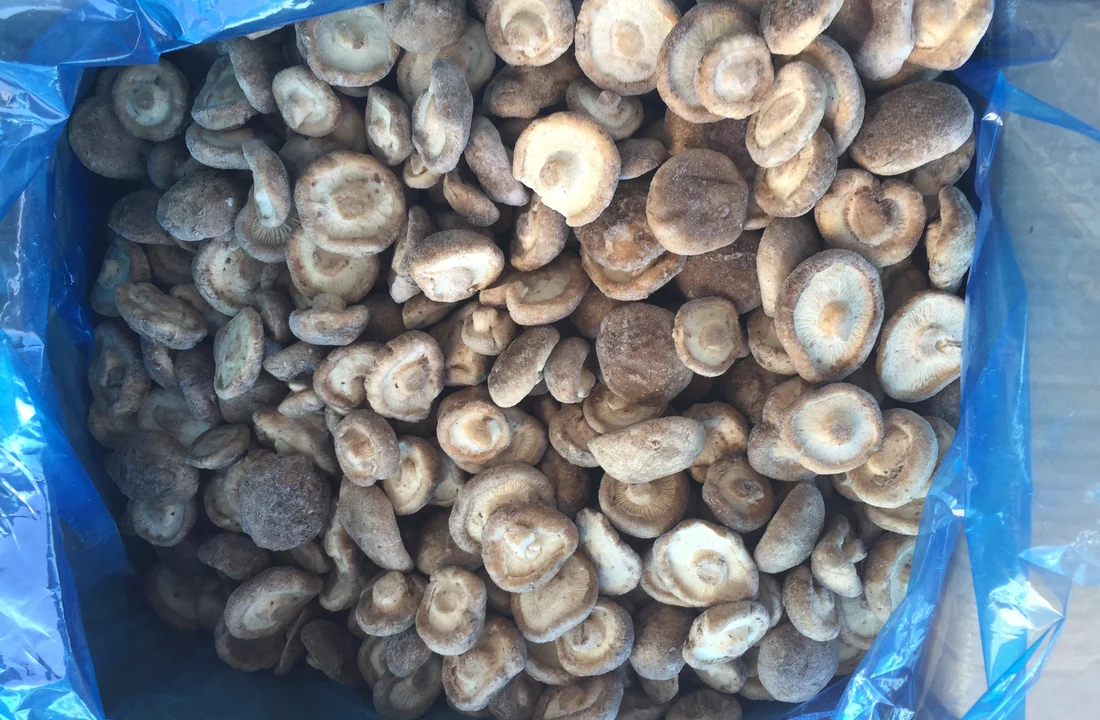
Real frozen whole shiitake form; no yield or cooked result is implied.
These whole frozen caps show one water-containing form. They cannot tell you how much usable mushroom a soup will contain. For a frozen-slice trial, weigh the frozen material as received and note whether the process adds it directly, thaws it under the product instructions, or separates released liquid. Keep that choice constant in repeat trials. If released mushroom liquid enters the kettle, count it in the recipe’s water balance. If a process drains it, record the drained mass and recognize that the trial now tests a different route. Do not quietly compare a drained frozen sample with a dried sample whose soak liquid is retained.
For dried shiitake, record the dry input and the rehydrated piece mass after a consistent drain step. Record the remaining soak liquid separately. Rehydrated mass is not the same as dry mushroom solids: much of the increase is water. A supplier’s “rehydration ratio” also depends on its definition, time, temperature, piece size and drain method. Two ratios from different methods cannot support a purchasing decision until the measurement basis is aligned. The shiitake study above measured drained mushroom weight and also examined material lost into rehydration water; that is precisely why the pieces and the liquid should remain separate entries in a production worksheet.
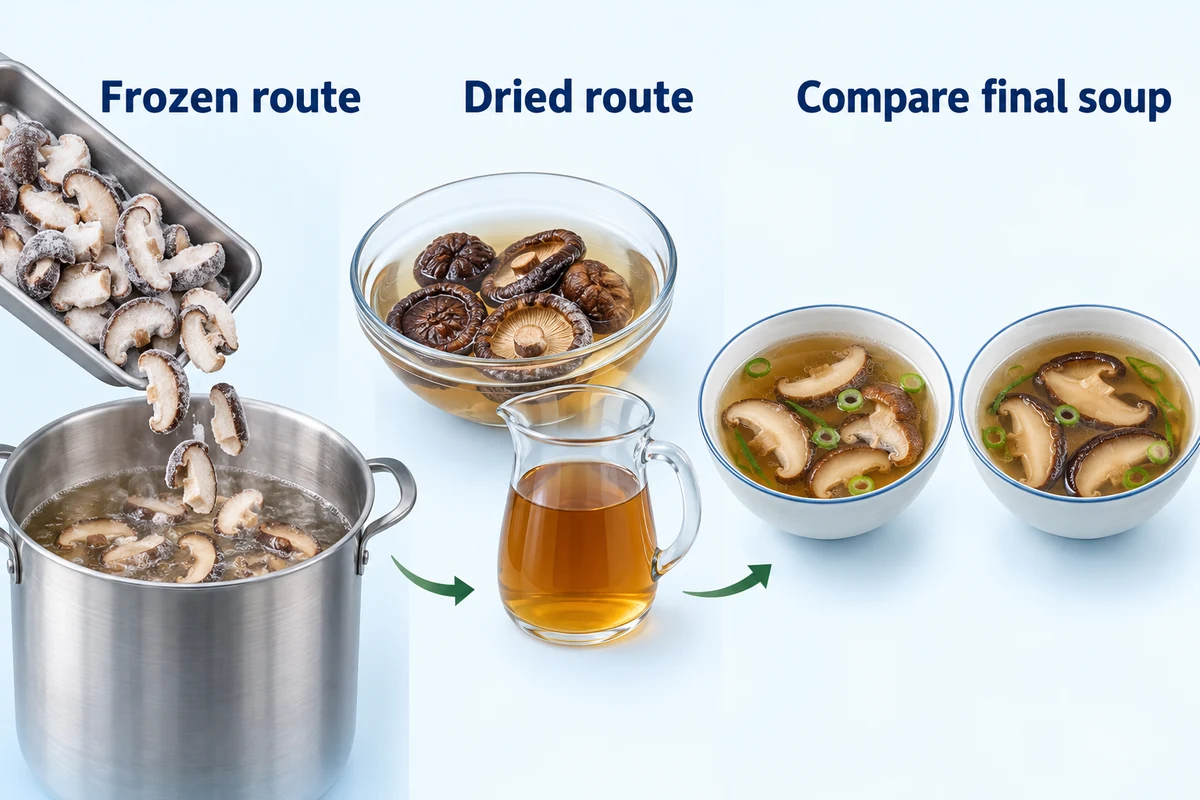
Conceptual recipe comparison; no quantity or sample outcome is shown.
Consider a hypothetical trial design with two small soup kettles. Both start from the same base and target the same finished mass. In the dried route, a portion of the recipe water is used to soak the mushrooms; the recipe team decides whether filtered soak liquid returns to the kettle and adjusts the other water accordingly. In the frozen route, slices enter under the agreed handling method and any liquid they release is counted in the final mass. No dry-to-frozen multiplier is assumed. The team weighs the cooked batch and corrects only to the pre-set finished mass before sensory evaluation. Those steps make the comparison interpretable; they are not a reported XMG or customer test.
If cost is part of the decision, compare more than the invoice price per packaged kilogram. Use the agreed cost per finished usable batch after documented water additions, prep loss, portion yield, labor, storage and handling. A dry ingredient can be economical where transport and storage dominate, yet less convenient if a short production window cannot accommodate rehydration. A frozen ingredient can simplify dosing but requires a controlled frozen route and may not give the desired extracted broth note. These are decision variables, not universal rankings or quotations.
Decide what to do with the soaking liquid
The soak liquid can carry flavor compounds. The drying study above measured loss of dry material into the rehydration water under its laboratory conditions, while a dried-shiitake producer’s guidance [2] describes using that liquid in broth. That supports treating the liquid as an ingredient to evaluate, rather than automatically discarding it. It does not establish that every soak liquid has the same flavor, appearance or suitability for every recipe.
Separate two questions. First, do the rehydrated pieces meet the required size, bite and appearance? Second, does the liquid improve the soup or sauce after it is filtered and incorporated under the recipe’s handling instructions? In a clear soup, color or suspended particles may matter as much as savory depth. In an opaque sauce, color may matter less while viscosity and aftertaste matter more. A single “use all the soak liquid” rule misses both applications.
For a controlled bench trial, use one documented soaking method for each dried candidate and note water type, water-to-product amount, time, temperature, piece size, drain method, filtration, liquid retained and final use. Follow the dried product’s actual supplier instructions and the kitchen’s food-safety program. The research paper’s laboratory 1:20 rehydration method was chosen for measurement, not as universal kitchen advice. If the team changes the soak method between trials, it should mark the comparison as a new trial rather than combining the outcomes.
If the liquid is rejected for a given product, document why: unwanted cloudiness, flavor imbalance, particulate matter or a recipe decision. Then compare the rehydrated pieces alone with the frozen pieces at the same cooked recipe mass. If the liquid is retained, reduce other added water so that the finished batch remains comparable. Do not report the retained-liquid sample as if only the mushroom solids had changed. This simple record prevents a common false conclusion: that one mushroom form “made a stronger soup” when the real difference was an extra concentrated liquid entering one kettle.
The same logic applies to sauces. A sauce developer may use the liquid for a mushroom-forward base, but should observe whether it changes reduction time, salt perception or the behavior of thickening ingredients. Record the actual finished viscosity or a consistent sensory description under the same serving temperature. Do not claim a particular concentration or reduction percentage without a defined test and lot. The aim is to decide whether the liquid belongs in this sauce, not to label it universally valuable or wasteful.
Trial soup and sauce separately
Soup and sauce place different demands on the mushroom. In a clear soup, the broth may be the first thing a customer notices, yet visible pieces still need to survive ladling and holding. In a sauce, mushrooms may be finely distributed and the decisive issue could be the balance between savory depth, texture and the sauce’s body. A form that performs well in one should not be carried into the other without a separate finished-product check.

Illustrative trial design, not a real XMG or customer evaluation.
Set the comparison before anyone tastes. Use the same base recipe, seasonings, target final mass, kettle or pan scale, heat treatment, tasting temperature and holding interval. Name one frozen candidate and one dried candidate by lot and form. Keep the dried soak method fixed; decide whether its liquid enters the formulation. Keep the frozen addition method fixed too. Then prepare paired batches and label them with neutral sample codes for tasters. This is a proposed method for a buyer trial, not an assertion that XMG has run such a test.
Ask tasters to score or describe separate attributes rather than “which is better?”: mushroom aroma at serving, savory taste, any bitter or muddy note, color, broth clarity or sauce appearance, and the bite of an identifiable piece. Add an operational observation from the cook: whether the input clumped, how easy it was to dose, how much trimming or filtration occurred, and whether the planned timing was realistic. Record exact conditions and descriptive results, then decide which difference matters for the product. A blind tasting helps reduce expectation bias, but it cannot replace measurement of yield and process time.
For visible pieces, inspect after the normal cook and again after the longest intended hold. Count a representative serving or compare a fixed weight of finished food. Note whether slices remain recognizable, whether stems feel woody, whether broken pieces or fines accumulate, and whether the sauce or soup releases excess liquid on standing. A small sample that looks good immediately after cooking can behave differently after hot holding or reheating. The evaluation should follow the actual product path, not a convenient short bench cook.
Run at least one repeat when the first outcome is close. A repeat is especially useful if the dried candidate varies in size or the frozen candidate includes a wide slice-thickness range. Record the lot and sample preparation each time. If the result changes, investigate whether the ingredient form, the preparation method or the base recipe caused it. An unrecorded recipe tweak can make an ingredient look more or less capable than it is.
Include preparation and handling in the decision
A formulation can taste excellent and still be a poor production fit. Dried shiitake may need a planned soak, a suitable vessel, liquid handling, trimming and a defined point of addition. Frozen slices need frozen storage, portioning and a route into the cooker that fits the line’s temperature and timing controls. Those tasks use different space and labor. Ask the production team to time them in the same trial that measures sensory performance rather than assigning a generic “easy” label to either form.
Keep culinary performance separate from food-safety approval. Follow the actual product’s storage, cooking and handling instructions and the facility’s validated food-safety plan. A home recipe or a laboratory rehydration protocol is not a substitute for a commercial process. If a change in form changes the heating step, hold time or packaging, the relevant QA team should review that change. This article does not define a universal microbiological limit, shelf life or reheat temperature for either form.
The purchase specification also needs a scope. “Dried shiitake” may cover whole caps, slices or powder, and drying method can affect how the material rehydrates. “Frozen shiitake” may mean whole caps, slices, dice or a prepared mixture. Record species, form, cut, stem inclusion, broken pieces and any pre-treatment that the supplier declares. Do not assume a freeze-dried product is the same as an IQF frozen product simply because the word “freeze” appears in both descriptions.
If the recipe needs a mushroom note without visible pieces, a separate dried extract or powder trial may be more relevant than a whole-cap comparison. If the recipe promises generous recognizable slices, review the cooked piece distribution and slice integrity before a flavor concentrate. The first question is always the intended role in the finished food. The ingredient brief should follow that role, not an abstract preference for frozen or dried.
Write a usable frozen-shiitake brief
If the controlled trial points toward frozen sliced shiitake, give us the application and the observations behind that choice. Specify the intended cut and thickness direction, whether stems are acceptable, the tolerated broken/fine fraction, pack size, portioning method, destination and the cooked result that must be demonstrated. Attach the soup or sauce trial method and the acceptance reference if you have them. These details let us discuss a relevant sample with the applicable partner factory instead of offering an attractive photograph that does not match your process.

Real frozen sliced form; define acceptable cut and cooked condition in the order brief.
Use the sliced product image above to discuss the cut, then approve actual thickness and cooked integrity against a proposed sample. Our product specifications and sampling guide explains how a sample and the agreed acceptance basis should connect. The current IQF sliced-shiitake product page also identifies slice thickness, stem direction, fines and cooked results as decisions to confirm for the actual order.
If dried shiitake remains the preferred route, keep its supplier instructions and specification beside the formulation record. Keep a frozen-slice quotation separate from that alternative. When the two routes are close, retain both trial records with the same finished-mass basis. That record makes it easier to change the recipe intentionally later or to explain why a buyer selected one route for soup and another for sauce. For another ingredient-pair decision, our nameko-versus-shiitake soup guide examines a different question: which mushroom species and form give the required broth and bite.
Review your frozen-shiitake requirement with XMG
Frozen Sliced Shiitake
Review our frozen sliced shiitake range, product forms and specification options.
View Frozen Sliced Shiitake →References
- [1] Original study of drying treatment, rehydration, structure and sensory quality in shiitake↑. Research treatments and results are not XMG commercial lot data.
- [2] Dried-shiitake producer FAQ on soaking and use of soaking liquid↑. Supplier use guidance is product-specific.
