


On this page
Frozen green beans need separate acceptance lines for diameter, tough strings and cooked eating quality. A bean can fit the agreed size opening and still have an objectionable strand or fibrous pod wall. The inspection result also depends on what was tested: five affected units out of one hundred is a different statement from fifty grams of affected units in a five-hundred-gram sample.
Before comparing quotations or disputing a delivery, establish the bean type, cut style, preparation method, defect definition and calculation basis. Then compare each result with its own agreed limit. A size name such as “fine” helps describe the product, but the numerical specification and inspection procedure make that description usable.
Separate diameter, strings and cooked eating quality
Diameter describes a dimension across the pod. A string is associated with a strand running along it. Cooked pod-wall quality concerns what remains of the wall when the prepared bean is assessed. These observations can concern the same unit, yet answer different questions. Combining them into one “tender grade” field hides the reason a buyer accepts or rejects the sample.
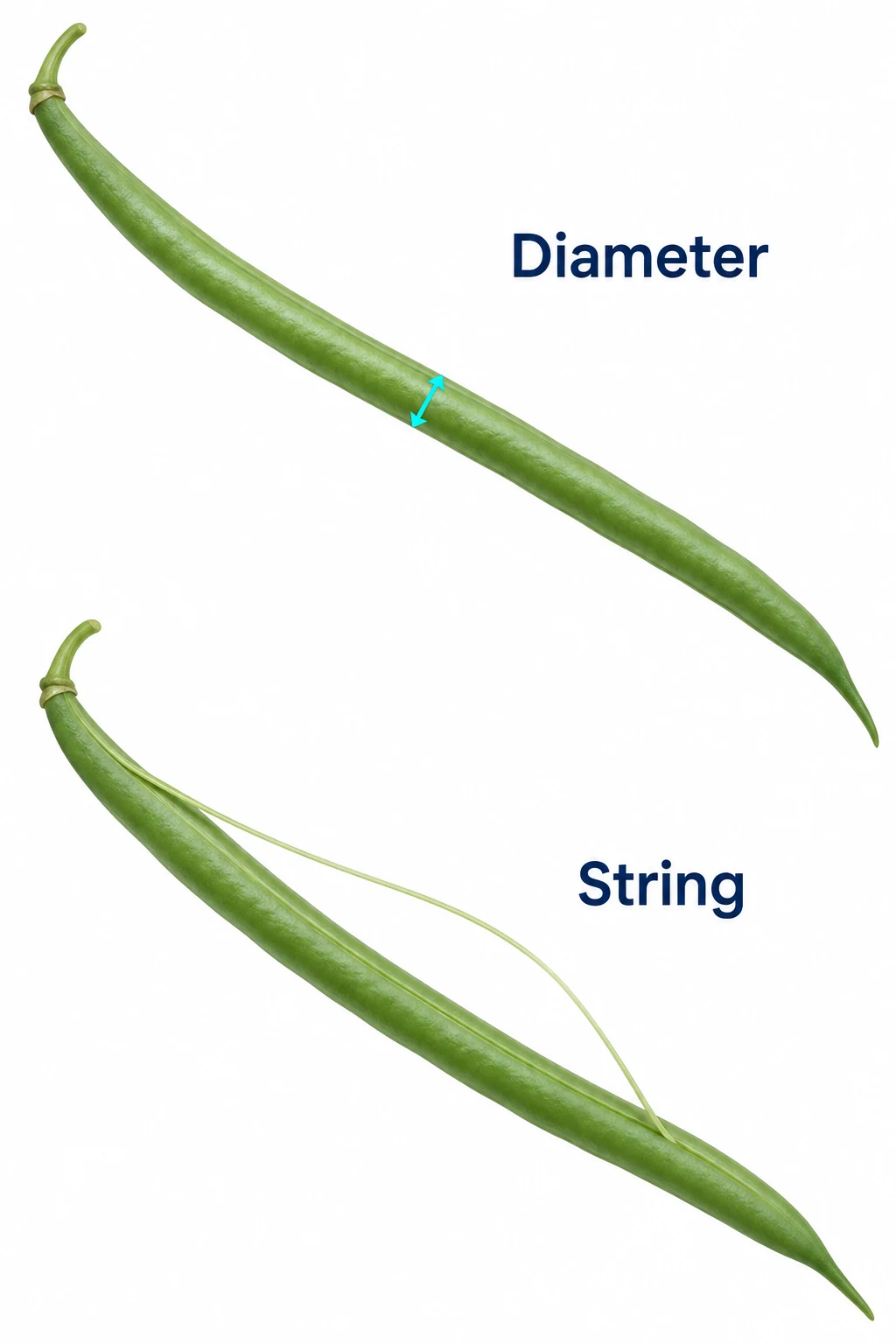
Illustrative landmarks: diameter is measured across the pod under a specified method; a string runs along it. The drawing does not establish a grade or show a completed tough-string test.
The USDA frozen green and wax bean standard [1], effective August 1996, treats size separately from quality grade. Its quality framework includes cooked character and fiber, alongside other prerequisites and defects. The terms edible and inedible fiber describe pod-wall eating quality after cooking; they are not nutritional dietary-fiber measurements.
For an ingredient buyer, the distinction changes the corrective question. An excessive proportion of large-diameter beans prompts a review of the requested size distribution. An objectionable strand prompts a review of the string definition and test. A tough or separating cooked wall calls for the relevant texture assessment. Repeating only the diameter measurement will not resolve all three complaints.
A useful report therefore keeps three visible findings, even when the final commercial decision is one approval or hold. It identifies the size result, the defined string result and the cooked-wall observation. Any conclusion about the lot then follows the agreed sampling and acceptance plan, rather than a general impression from the best-looking handful.
Name the bean type and the numerical size rule
Start with the product being purchased: round or flat type, and whole, cut or lengthwise-cut style. A width across a flat pod is not automatically interchangeable with the sizing convention for a round bean. Nor is the length of a cut segment its diameter. Mark the relevant dimension on a simple drawing attached to the specification if the terminology has caused disagreement.
Supplier size names also need numbers. [2] lists its “Fine” green beans at 8–9 mm. The green-bean annex of Codex CXS 320-2015 uses its own round-type designations, including “Small” with a maximum diameter of 9.5 mm. These are examples from different systems, not a translation table that makes every supplier’s “fine” product equivalent.
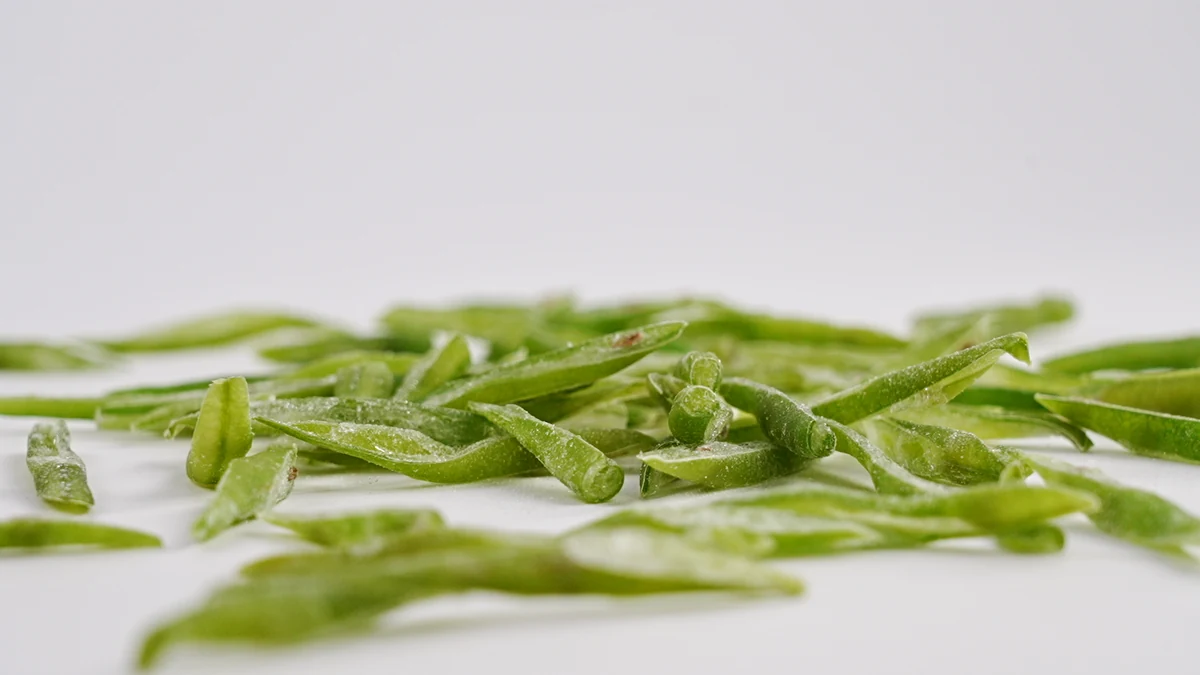
Original video frame of cut green beans. Confirm the product style before applying the relevant dimensional and defect rules.
Write the lower and upper boundaries, whether each boundary is inclusive, and the treatment of smaller and larger units. A maximum-size designation does not necessarily mean a closed band between two neighbouring table values. Likewise, “at least a stated proportion of the declared size or smaller” has a different meaning from “within the quoted two-sided range.” Preserve those differences when preparing a purchasing summary.
The document’s scope matters too. CXS 320-2015 supersedes the earlier dedicated frozen-bean standard, CXS 113-1981. Its general scope excludes products indicated for further processing or other industrial purposes. An industrial buyer can agree suitable contractual criteria, but should establish the relevant scope instead of assuming that the whole Codex product standard automatically applies to every ingredient order.
Measure the specified dimension in a defined state
The USDA grading manual [3] describes sieve sizing by the opening through which a bean’s narrowest width at its thickest portion passes without resistance. That is more specific than placing a ruler anywhere across a photograph. The green-bean annex of CXS 320 specifies parallel-bar sizing of thawed round-type whole and cut beans. Use the preparation and measurement instructions belonging to the chosen method.
An inspection work instruction should make the operator’s choices reproducible. Identify the gauge or instrument, the measurement location, sample state, handling of bent or split units, and the rule at a boundary. If a caliper replaces a reference gauge, establish whether the alternative measures the same property and is accepted by both parties. A digital display by itself does not establish equivalence.
For example, one operator might select the largest-looking span of a curved pod while another tests passage through a specified opening. Their numbers can differ because their procedures differ. Begin a reconciliation by reproducing the documented procedure on identified retained units. Do not immediately adjust the tolerance to make the two sets of numbers agree.
The same care applies to the sample’s preparation. Record whether the method calls for frozen or thawed product and how that state was achieved. Do not let one laboratory’s analytical preparation become an informal handling instruction for saleable stock. Keep the tested portion identifiable, and keep any food intended for consumption within its applicable approved preparation controls.
A photograph can show where a measurement was taken or document a visibly split piece. It should accompany the actual readings, instrument record and sample identity. Without those records, the image cannot establish the size distribution of the sample, much less that of the whole lot.
Keep the result tied to its count or mass basis
Percentages are only comparable when their numerator and denominator match. Consider a hypothetical set of 100 bean units with a combined mass of 500 g. Five units are flagged under a stated rule, and those five together weigh 50 g. The flagged proportion is 5% by number and 10% by mass. Both calculations describe the same set correctly.
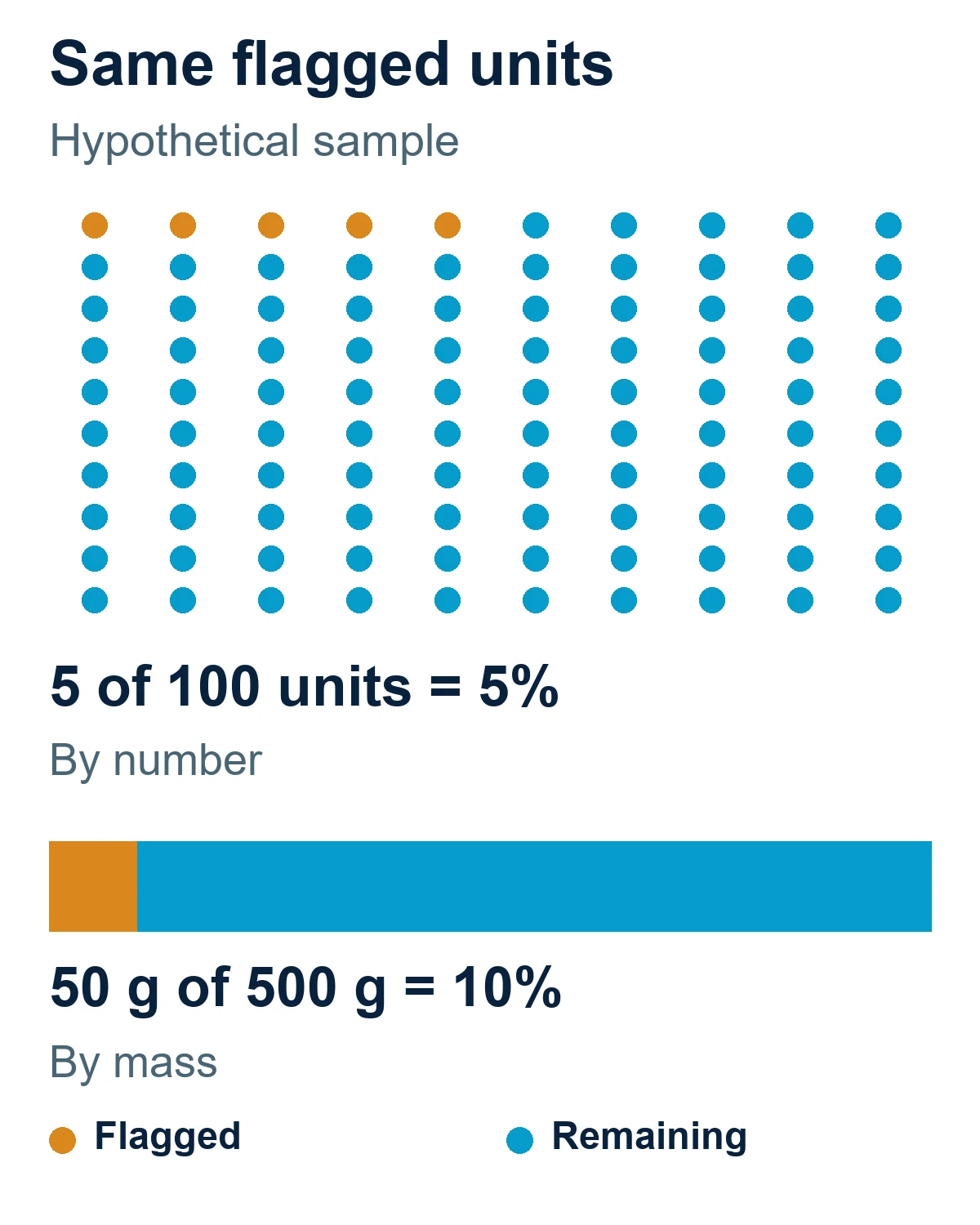
Hypothetical arithmetic: the same five flagged units among 100 weigh 50 g within a 500 g sample. The upper marks represent units; the lower bar represents mass. No acceptance threshold is implied.
The difference does not show that either calculation is more accurate. One describes the share of units; the other describes their share of the mass. A result reported simply as “5% defects” leaves the recipient to guess which calculation was made. The example provides no acceptance threshold and says nothing about the proportion in an unexamined lot.
Record the actual total and affected amount beside the percentage. For a count result, retain the total number examined and number meeting the particular defect definition. For a mass result, retain the prepared sample mass and the mass of the defined affected material. If the method weighs affected bean units, weighing only material pulled from those units changes the numerator.
The unit itself also needs definition. An intact pod, an individual cut portion and a collection of detached strands are different things to count. Cutting one pod into several portions can change the number of units represented without changing the original amount of bean material. Avoid reconstructing an unstated count from a sample’s weight or a photograph.
When a supplier’s report and a buyer’s report disagree, align these fields before comparing percentages. If only the final percentage survives and the underlying amounts are missing, the evidence may be insufficient to convert the result. Request the original worksheet or run an agreed examination; do not manufacture a conversion factor from a typical bean weight.
Define what qualifies as a tough string
The current recommended-methods document, CXS 234-1999 as amended in 2026, includes the Codex tough-string procedure in Appendix XII. Its qualification test uses a clamp-and-weight assembly with a total mass of 250 g and a five-second holding criterion. The representative drained test sample is at least 285 g, and the actual sample mass is recorded. These are method details, not the lot’s permitted defect level.
The crucial calculation concerns the bean units containing qualifying tough strings. Those units are retained and weighed; the reported mass percentage uses that affected-unit mass against the test-sample mass. It is not the mass of isolated strings. The complete method includes handling and retesting instructions, so this explanation should not replace the laboratory’s controlled procedure.
Before commissioning a test, ask how the requested acceptance field connects to that result. Does the contract adopt this method and a mass limit, or does it use another named definition and decision scheme? A laboratory can correctly perform one test while the purchasing document asks an insufficiently defined question. Resolving the document mismatch is part of preparing the test request.
Keep the physical qualification criterion and commercial limit in separate fields. Changing the load, duration or identification rule changes what qualifies for the numerator. Changing only the permitted result changes the acceptance decision. Neither change should be hidden inside a revised spreadsheet heading called “strings.”
If a retained unit is examined during a complaint review, connect its photographs and observations to that unit’s identifier. “A strand was visible” and “the strand met the specified tough-string criterion” are different observations. The worksheet should preserve which one was actually established.
Assess the cooked pod wall separately
A pod may contain a visible strand, have a fibrous wall, show enlarged seeds, or present more than one of these features. A single photograph is a useful location reference but does not establish the cooked eating result. Evaluate the required characteristic using the preparation and assessment procedure agreed for the actual product style.
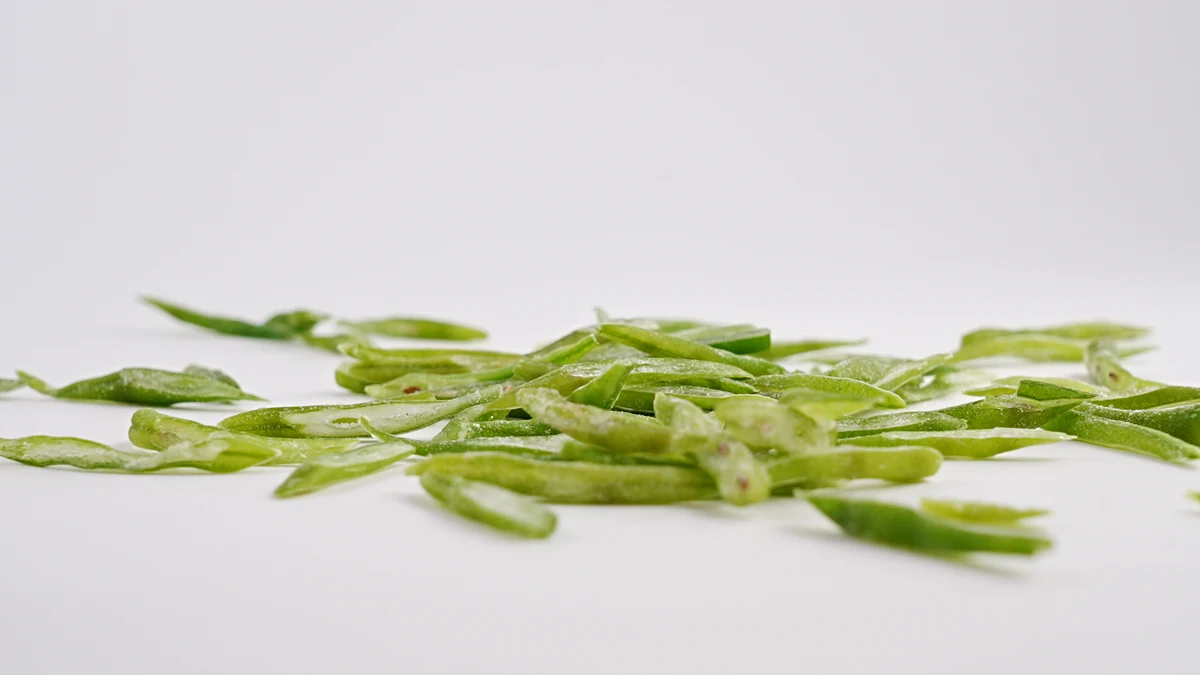
A second original video frame shows cut pod walls and seeds. Cooked wall quality is assessed separately using the agreed preparation and terminology.
Iowa State University Extension [4] explains that developing seeds and advancing maturity can accompany tougher, stringier pods. That horticultural relationship helps explain why maturity enters a quality discussion. It does not create a universal frozen-bean diameter above which every pod fails, or below which every pod must be tender.
The USDA manual treats jagged cut edges as a possible clue to fiber, not conclusive evidence. Its cooked assessment distinguishes the relevant fiber observations from character. Follow the chosen terminology consistently rather than assigning a cooked defect from an uncooked visual clue alone.
For a buyer’s application trial, agree the prepared product and the observation point. A bean evaluated immediately after a defined preparation is not necessarily the same assessment as one in a finished meal after the buyer’s normal approved process. Keep the ingredient inspection and the finished-application trial as identifiable records, with a clear purpose for each.
Describe the finding concretely: a persistent strand, a separating wall, an objectionable wall texture, or another defined observation. “Too old” is a conclusion about history that may exceed the evidence. A useful record gives the supplier enough detail to investigate while leaving unsupported explanations open. Sensory examination addresses quality; it does not clear an unresolved food-safety concern.
Read the entire defect schedule before deciding
A published Ardo whole-bean specification, BH2610 version 014, revised in 2014 [5], provides a useful document-reading example. Its headline gives 6.5–8 mm and an 80% statement without naming the calculation basis there. The detailed schedule separately places off-size material at 75 g per 500 g and uses other denominators for other defects. It also defines strings and lists a gram-based allowance. The reader must clarify what is weighed rather than assume isolated strands.
This historical supplier document is not an XMG specification or a statement of current availability. Its value here is the reading discipline: connect each definition to the correct row, sample amount and calculation. Do not take a headline percentage from one part of a document and attach it to a different defect below.
There may also be separate individual-sample and lot-level decisions. The USDA standard’s unofficial single-sample basis is 400 units for styles other than French and 500 g for French style; official lot inspection has its own requirements. Those figures are not a recommendation to select that amount for every commercial inspection. Identify the intended inspection route before borrowing a sample size or acceptance number.
Check how overlapping defects are recorded. A damaged unit may also exhibit another relevant characteristic. Whether it contributes to more than one field must follow the selected schedule, rather than an operator’s wish to keep totals below one hundred percent. Equally, adding unlike counts, masses and scores into a single defect total can produce a number with no defined meaning.
Where a contract adapts a standard, identify the adopted clauses and any agreed departures. Avoid a document that names one standard at the top but silently changes the sample basis or defect definition in the table. Both laboratories should receive the same controlled version before they begin.
Build a sample report that explains disagreements
A practical comparison starts with two identified records, not two unexplained percentages. Retain the lot and pack references, sampling location and selection method, sample identifiers, condition on receipt, preparation instructions, method version and operator or laboratory. Then attach the original amounts, calculations and observations to the relevant field.
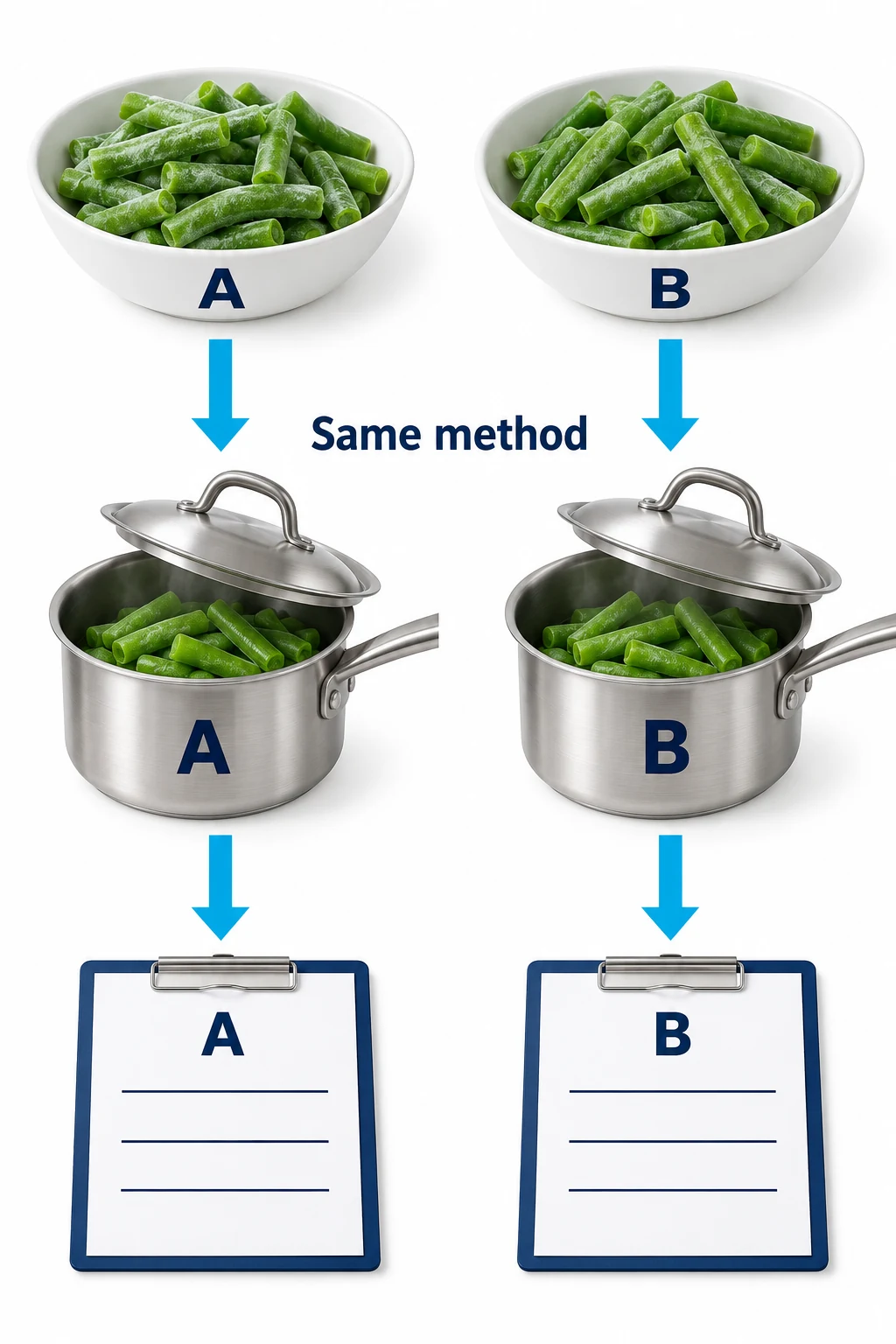
Illustrative sample tracking: A and B retain their identities through the same selected method and separate observations. The drawing supplies no cooking parameters or test results.
Suppose report A says the diameter distribution is acceptable while report B identifies objectionable cooked walls. These findings are not necessarily contradictory: the reports may be answering different questions. If both claim to report the same characteristic, compare product style, preparation, measurement method, defect definition and denominator in that order. This often reveals what further examination is needed.
| Report field | What the record needs to show | Question it resolves |
|---|---|---|
| Diameter | Defined location, sample state, gauge and size distribution | Was the agreed dimensional rule examined? |
| Tough strings | Named method, qualifying units and its calculation basis | What actually entered the affected amount? |
| Cooked wall | Identified preparation and defined observations | Was the required eating characteristic assessed? |
| Decision | Applicable limit, sampling plan and authorised disposition | How does this evidence affect the sampled lot? |
Preserve the original result when an agreed repeat examination is performed. Label the repeat with its reason, sample identity and any procedural change. A different preparation can answer a useful new question, but should not be presented as though it automatically invalidated the first observation. The resulting decision needs to explain which evidence was relevant and why.
Turn the findings into separate purchase conditions
Replace a broad request such as “fine, tender beans with no strings” with several connected conditions. Specify the bean type and style, numerical diameter rule, permitted distribution, named string definition and method, and cooked-quality assessment. Give each applicable result its own basis and agreed acceptance criterion. Leave unresolved values visibly open until both sides confirm them.
The sample approval should identify the version of those conditions that it supports. If the approved sample demonstrates appearance and application fit, say so; do not treat that approval as evidence that every analytical or lot-inspection requirement has already been met. Link the production or pre-shipment evidence to the relevant order and sampling plan when it becomes available.
For repeat purchases, investigate changes against the original fields. A new cut style, different size range or revised preparation can alter how a result should be interpreted. Keeping diameter, tough strings and cooked wall quality separate allows a focused correction without loosening unrelated requirements. It also gives the receiving team a clear basis for checking that the proposed correction worked.
Frozen Green Beans
Review our frozen green beans range, product forms and specification options.
View Frozen Green Beans →References
Primary sources reviewed on 11 September 2026. Standards and supplier documents are used within the scopes described above; historical supplier examples do not establish XMG order terms.
- USDA Agricultural Marketing Service. [1] United States Standards for Grades of Frozen Green Beans and Frozen Wax Beans↑, effective August 1996; [3] Grading Manual↑, October 1996, relevant grading procedures.
- Codex Alimentarius. CXS 320-2015, Standard for Quick Frozen Vegetables, amended 2022: general scope and green-bean annex. CXS 234-1999, Recommended Methods of Analysis and Sampling, amended 2026: Appendix XII and relevant analytical preparation appendices.
- Ardo. [5] Whole beans very fine, BH2610 version 014↑, revised 29 September 2014.
- Congelados de Navarra. [2] Green Beans↑, commercial size descriptions.
- Aaron Steil, Iowa State University Extension. [4] Are large, bumpy green beans still edible?↑, updated December 2024; maturity explanation only.
