On this page
When two food laboratories report different results, first establish whether they tested comparable material and measured the same quantity on the same reporting basis. Then compare the methods, relevant performance information and uncertainty. A numerical difference alone does not identify which laboratory is wrong.
For a frozen-food order, preserve both complete reports and the original test request while the responsible technical team reviews the discrepancy. The next test, if one is appropriate, should address a defined question. Choosing whichever result is more convenient leaves the original disagreement unresolved.
Put the two complete reports beside the original request
A screenshot of two highlighted numbers is a poor starting point. Retrieve the full reports, including footnotes, result qualifiers, method references and any revised versions. Place them beside the specification and the request sent to each laboratory. This establishes what the teams intended to order and what each laboratory actually reported.

Original product photograph. Use the actual lot and sample records to identify the material represented by each report.
Start with document identity. Record the report number, issuing laboratory, test location where identified, sample identifier and relevant dates. Distinguish sample collection, receipt, analysis and report issue dates. A later report date does not necessarily mean the laboratory tested a later production sample.
Then identify the business decision affected by the discrepancy. Is the buyer reviewing a composition claim, a customer specification or another quantitative requirement? The applicable product, destination and decision rule should be clear. A difference that needs a technical explanation and a result that triggers a controlled product status are connected questions, but their actions may run on different timelines.
| Compare this field | Keep the original detail | Question to resolve |
|---|---|---|
| Sample identity | Product, lot, collected units and laboratory identifier | Were the laboratories examining comparable material? |
| Measured quantity | Named quantity, product state, unit and reporting basis | Do the numbers describe the same thing? |
| Method | Method reference, version and relevant preparation | Were suitable, comparable procedures used? |
| Result and uncertainty | Value, qualifiers, uncertainty type and coverage information | What comparison does the evidence support? |
| Assessment | Requirement, decision rule and authorised conclusion | How does the finding affect the actual order? |
Use a neutral comparison sheet. Enter what each report says before adding interpretations or requested corrections. If one field is absent, mark it as missing and ask for it. Copying an assumed method or unit into an empty cell can create an apparent agreement that the original documents never established.
Check for a revised report as well. A laboratory may have issued a documented correction or clarification. Retain the version history and understand which change was made. Replacing an earlier file without recording the reason can obscure whether the issue was a transcription error, a reporting amendment or something that required further analytical work.
Quantitative results require a different comparison from qualitative outcomes. Presence-or-absence microbiological findings and other qualitative outcomes need their own method-specific interpretation and response. They should not be converted into a simple numerical uncertainty comparison. Where a result could affect food safety or legal compliance, the applicable technical and regulatory response takes priority while the evidence is investigated.
Confirm the quantity and reporting basis are the same
Two reports can name the same food component while reporting different quantities. The metrology definition of a measurand [1] concerns the quantity intended to be measured and requires enough information about the substance and its relevant state. For a buyer, the practical question is whether the result headings and associated notes define the same measurement.
Read the unit in full. A value expressed per kilogram should not be compared directly with one expressed per hundred grams. Equally, a unit conversion does not resolve a different reporting basis. Confirm whether the result concerns the product as received, dry matter or another defined material state before anyone rearranges the numbers in a spreadsheet.
In an illustrative composition review, one report could express a result on the product’s original mass basis while another uses a dry-matter basis. The values might differ even if both laboratories performed their stated work correctly. Ask the laboratories to explain the bases and any valid conversion information; do not assume the missing moisture information or calculate a conversion from another batch.
The tested part of the product also needs definition. For a food supplied with liquid, or a sample that changes during preparation, ask what material was included in the test portion. The agreed procedure may specify that clearly. The purpose of the review is to recover that definition, not to propose a new draining, thawing or preparation method after seeing the results.
Preserve result qualifiers. A value reported below a method’s quantification limit is not the same as a measured zero. A screening entry may not have the same status as a confirmed result. If the reporting language is unfamiliar, request the laboratory’s explanation and retain it with the comparison rather than substitute an informal word such as “clear”.
Precision in the written result matters too. Compare the underlying reporting rules before treating an extra decimal place as extra confidence. Rounding can alter how a result appears near a stated threshold, but a buyer should not round selectively to reach a preferred conclusion. Ask which value and rounding convention the applicable decision procedure uses.
Finish this stage with a short statement of what is comparable and what is still unresolved. For example, the product and unit may match while the preparation basis remains unclear. That is a useful finding: it identifies a specific question for the laboratories and prevents premature statistical analysis of unlike quantities.
Trace the sample paths before judging the laboratories
Establish whether the laboratories received separate samples collected from the lot, portions of a common laboratory sample or a documented split of prepared material. These arrangements can include different sources of variation. Two bags with matching product names do not automatically provide a controlled comparison of laboratory performance.
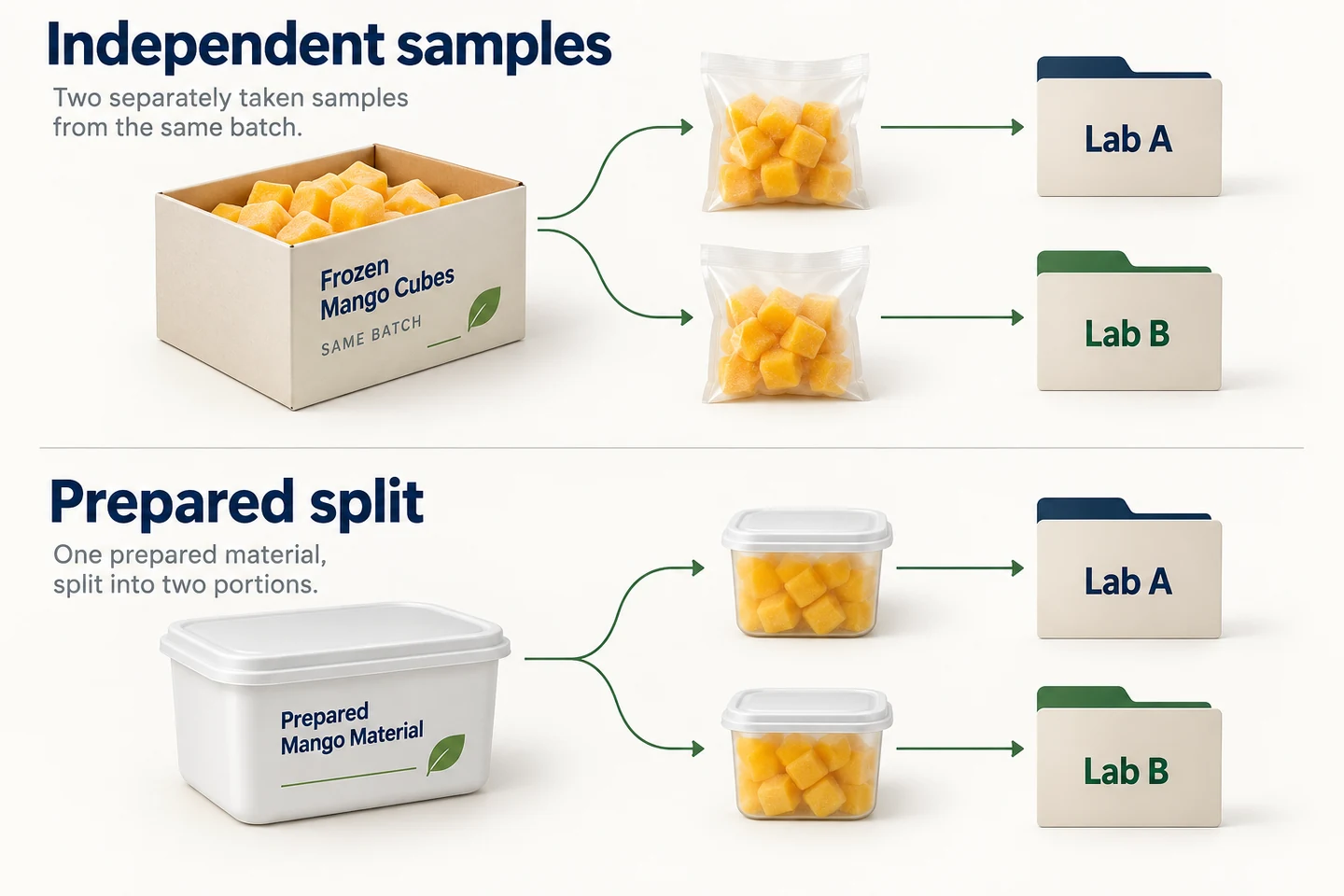
Conceptual sample paths, not a preparation procedure. A prepared split still needs demonstrated suitability for the proposed comparison.
Eurachem’s overview of uncertainty arising from sampling [2] distinguishes a result intended to describe a sampling target from one concerning only material delivered to the laboratory. For the wider target, sampling and preparation contribute to the measurement process. The overview also identifies material heterogeneity and variation in sampling practice as relevant influences.
For independently collected frozen-food samples, retrieve the collection records. Identify the lot, selected units, collection time, sample responsibility and handling requirements. If the two teams sampled different production periods or parts of a consignment, the investigation needs to consider that difference before assigning it to laboratory analysis.
Next connect dispatch with laboratory receipt. Review the identifiers, packaging condition, transport and receipt records relevant to the test. Ask whether either laboratory recorded a deviation or reservation. A statement that samples were “sent together” is incomplete if it does not establish what arrived, how it was identified and whether the required conditions were maintained.
Sample preparation requires the laboratory’s account. Confirm the preparation specified by the method and the material from which the test portion was taken. For frozen produce, the physical form and any handling before analysis belong in that account. Commercial staff should preserve those facts without inventing a preparation procedure or treating an undocumented change as immaterial.
A split sample can be useful for a defined investigation when qualified staff arrange suitable material, preparation, division and handling. It does not guarantee comparability simply because the containers have equal sizes. Ask how the material’s suitability for the proposed comparison was established and which remaining sources of variation the design is meant to include.
Decide what the investigation needs to distinguish. Reanalysis of retained prepared material addresses a different question from collection of a fresh sample from the lot. One may examine an analytical issue while the other includes another sampling event. If both are commissioned, label their purposes separately so the eventual results can be interpreted in the correct sequence.
Keep the original sample history visible even when later work is more controlled. A well-designed comparison can help explain the discrepancy, but it cannot recreate an undocumented earlier collection. Record that limitation openly and ask the responsible team how it affects the order decision.
Compare methods in their actual product context
A method name alone can leave substantial detail unresolved. Compare the reference and version, the named quantity, the product matrix and the relevant concentration range. Ask each laboratory whether its method was suitable for the submitted material and the required reporting purpose. The comparison should concern the work actually performed, not a general description of the laboratory’s services.
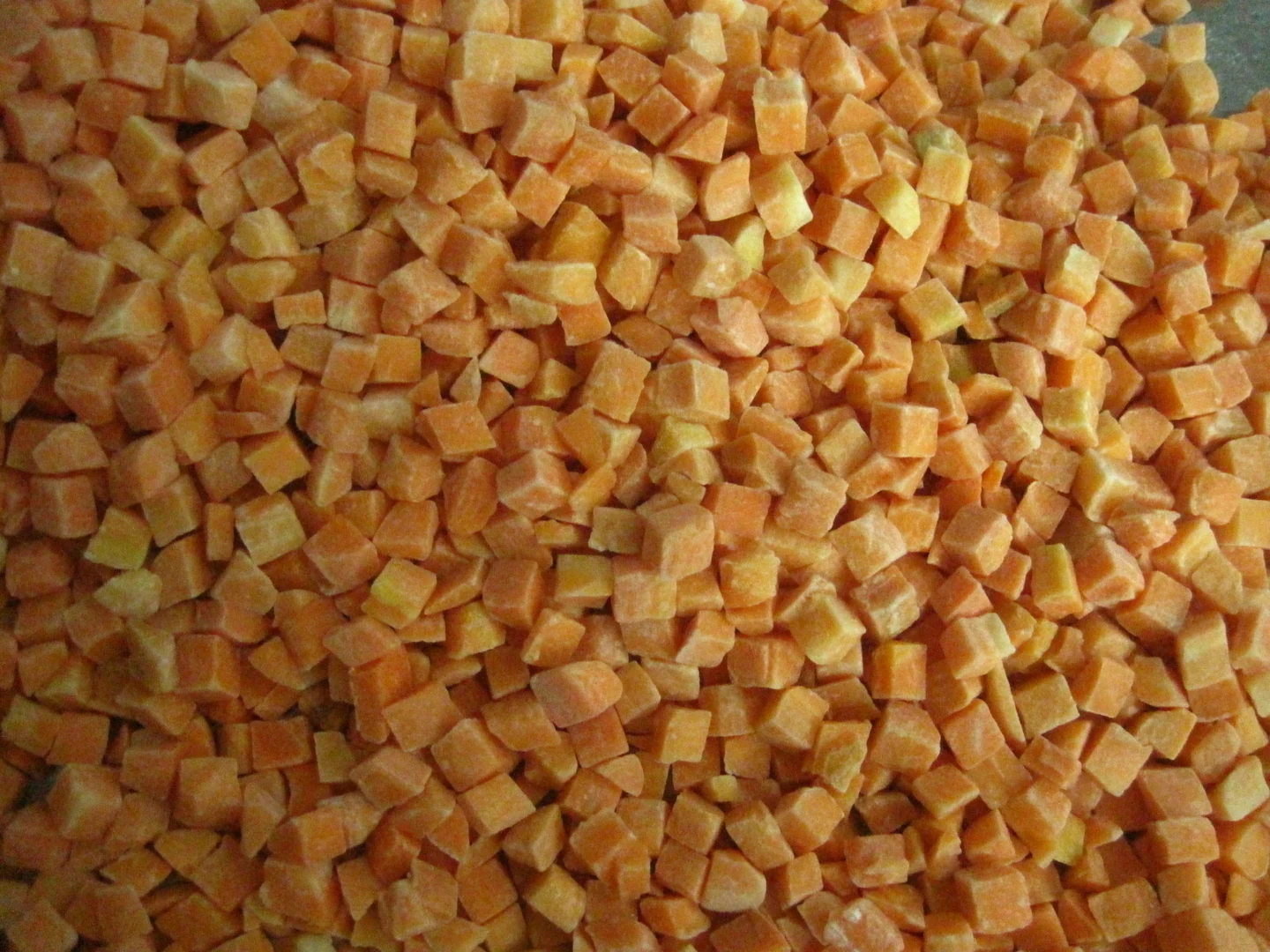
Original product photograph. Product form helps define the request; it establishes no analytical value or method performance.
For carrot dice, identify the actual product form and the material state covered by the request. Confirm how the laboratory described the sample and its preparation. A broad heading such as “vegetable analysis” may be inadequate for the particular quantity and reporting range under review.
Eurachem’s 2025 method-validation guide overview [3] connects fitness for purpose with validation, verification, sampling and handling, performance characteristics and method documentation. This provides a useful basis for the questions sent to a laboratory. It does not mean a purchasing team should try to reconstruct a complete validation study from a result certificate.
Where the laboratories used different methods, ask whether those procedures are expected to measure the same defined quantity and produce comparable results for the actual food. A difference in method code is a reason for technical review, not proof that one result is invalid. Conversely, identical codes do not establish that sample preparation and execution were equivalent.
Request the relevant performance explanation. Depending on the question, the laboratory may need to address selectivity, the useful measurement range, quantification capability, bias or precision. Keep the request tied to the observed discrepancy. A generic certificate bundle can miss the particular issue while adding unnecessary review work.
Check how corrections are reported where applicable. If one result includes a documented correction and another does not, the responsible analysts should explain what that means for comparison. The buyer should retain the original results and the explanation, rather than independently adjusting a reported value to bring the laboratories closer together.
Our guide to food laboratory accreditation and method scope covers qualification of the performing laboratory. For an existing disagreement, use that scope review to support the investigation while keeping attention on the actual samples and methods. Accreditation is relevant evidence of competence within its scope; it does not require two independent measurements to print identical numbers.
A productive technical exchange ends with an answer to the method question. The parties may confirm comparability, identify a known distinction or require further evidence. Record which conclusion was reached and what supports it before moving on to uncertainty arithmetic or another test order.
Interpret uncertainty on a common basis
Uncertainty gives context to a quantitative result. It does not identify a known mistake, and its absence from a short report does not establish that the result has no uncertainty. Ask each laboratory for the relevant uncertainty information and the scope of that estimate before comparing the two reported values.
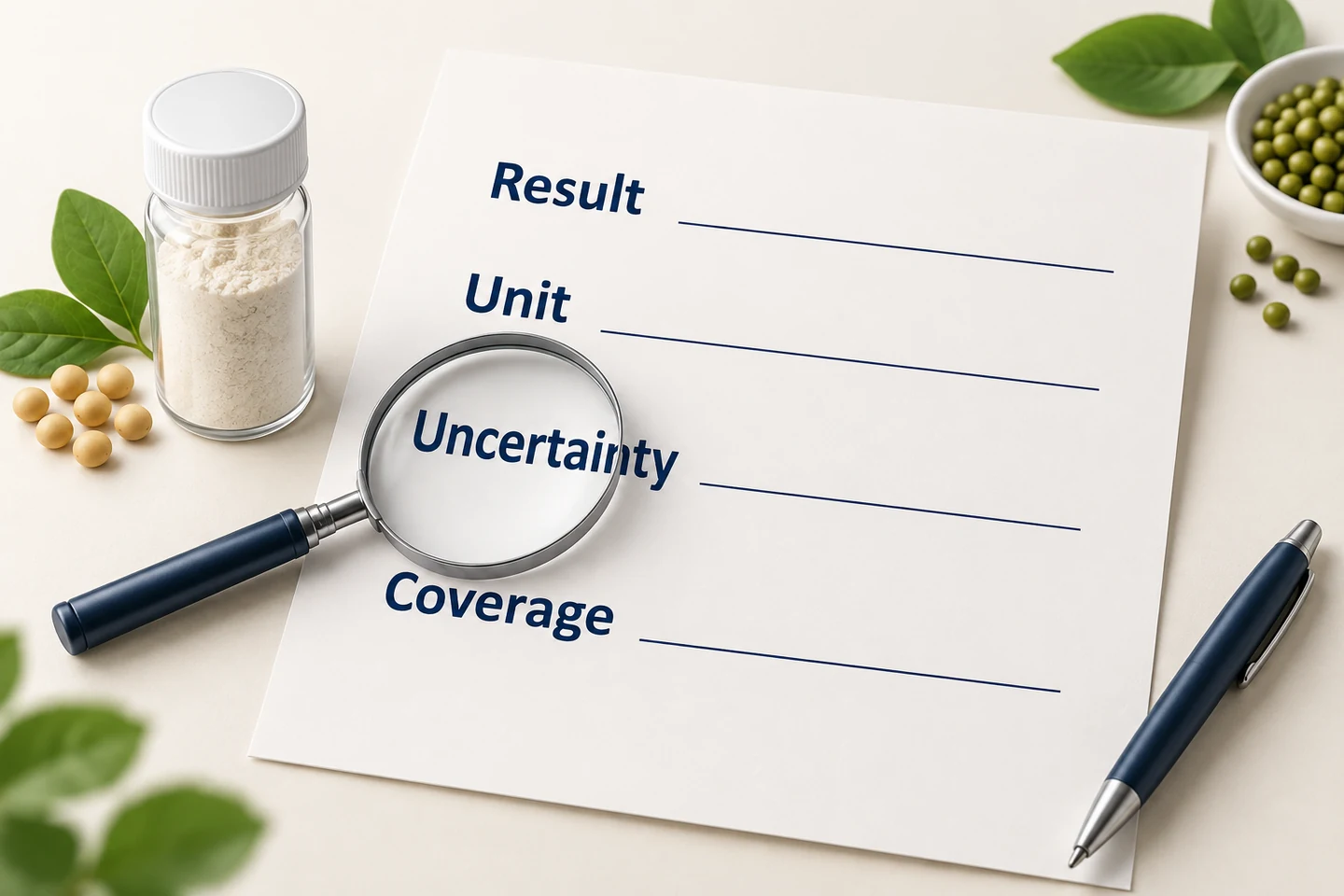
Conceptual blank report. No analytical value, actual sample preparation or laboratory certificate is represented.
NIST’s TN 1297 explanation of uncertainty reporting [4] distinguishes combined standard uncertainty from expanded uncertainty and connects the latter with a coverage factor. It also calls for a basis when a probability interpretation is supplied. In practical review, retain those descriptions with the number; an isolated “±” entry loses information needed to understand it.
Compare like forms of uncertainty. One laboratory may state an absolute value in the result’s unit while another states a relative value. A standard uncertainty and an expanded uncertainty are also different reporting forms. Have the responsible analysts place them on an appropriate common basis; do not assume every “±” figure uses the same factor or coverage interpretation.
The Codex guidelines on measurement uncertainty, amended in 2021 [5], address quantitative analysis and explain relevant laboratory contributions and reporting context. Their scope excludes uncertainty arising from collection of the lot sample. Ask what the laboratory’s estimate includes instead of assuming it covers the complete path from consignment selection to the final report.
The formal definition of metrological compatibility [6] considers the difference between results in relation to the uncertainty of that difference. It also notes that correlation between measurements affects the assessment. Looking only at whether two drawn uncertainty bars overlap is therefore an incomplete substitute for an appropriate technical comparison.
Let the analysts explain the assumptions and method used for that comparison. Shared reference information or other common influences may matter. If the samples do not represent the same intended quantity, the numerical comparison needs to state and address that mismatch. Resolve the sample and method questions first, and record any remaining qualification alongside the statistical conclusion.
Also distinguish compatibility from conformity. Two results can be sufficiently consistent for a particular comparison while the product’s conformity still requires assessment against the applicable requirement. Codex separates individual sample assessment from lot acceptance and stresses the role of agreed rules. A buyer should not turn an uncertainty illustration into an automatic shipment-release procedure.
Where uncertainty information changes the interpretation of a result near a limit, use the applicable decision rule and qualified review. Do not subtract a convenient uncertainty value from a result after the event to make it acceptable. The record should state how the rule was applied and who authorised the conclusion.
Agree the next investigation before commissioning another test
Another laboratory report is useful when its purpose is clear. Ask what remains unresolved: a reporting error, a difference between methods, variation in sampled material or another issue identified by the analysts. That question determines whether further document review, reanalysis or an appropriately designed new sampling exercise is needed.
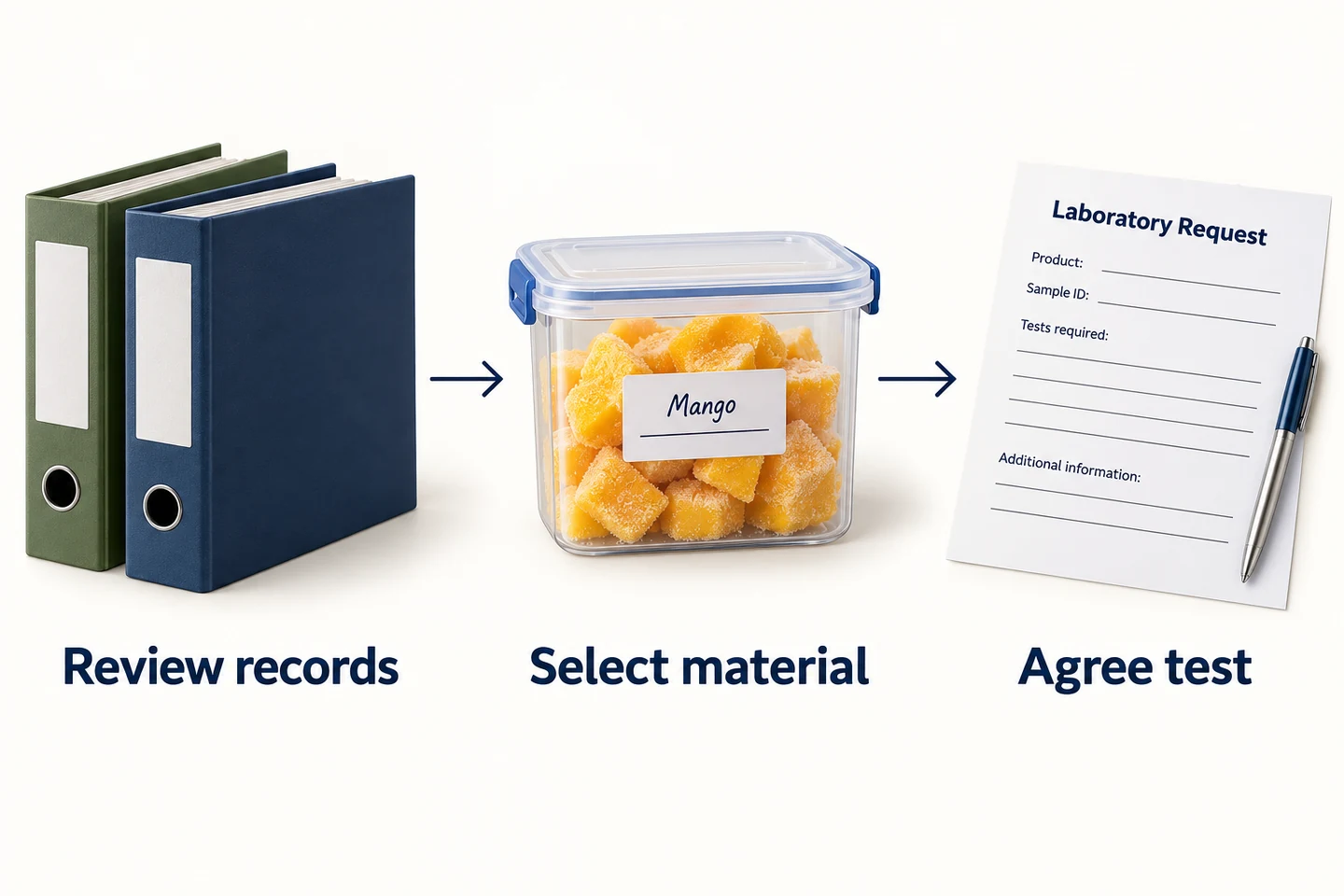
Proposed investigation sequence. The illustrated container and food do not specify an approved sampling or storage method.
Write the agreed question into the request. Identify the material to be used, the method or comparison arrangement, the required reporting detail and the responsible reviewer. If retained material is proposed, confirm its identity, suitability and availability with the party holding it. Retained samples should not be assumed suitable indefinitely or for every subsequent test.
In a proposed comparison of methods, the laboratories might need appropriately prepared common material and an agreed analytical plan. In a review of variation across the lot, a different sampling design may be required. These are examples of investigation purposes, not instructions to divide or prepare samples in a particular way. The qualified parties should design the work.
A third laboratory can contribute when selected for a defined role, including an agreed independent review or test. Its result should not be treated as a deciding vote simply because it resembles one of the first two. The same requirements for sample comparability, method suitability and interpretation still apply.
Preserve the original reports and link every subsequent result to the investigation. Record the reason for additional work, any changes to material or method and the conclusion it supports. If the investigation cannot resolve a gap, state what remains uncertain and how the responsible team addressed that limitation in its decision.
For an XMG order, we can coordinate the available product and lot records with the relevant partner factory and technical parties through our quality and inspection process. Agree any further work through the specification and sampling arrangements, including responsibility and reporting timing. The laboratories explain their methods and uncertainty; the authorised team makes the product decision.
Close the review with a concise account of the original discrepancy, the evidence examined, the explanation supported and the action taken. Connect any revised test requirement to future orders so the same ambiguity is less likely to recur. A useful outcome is a clearer measurement and decision process, supported by a record that another reviewer can follow.
Quality Control & Inspection
Review our inspection scope, sampling coordination and order-specific quality records.
Explore Our Quality Checks →References
- Eurachem. Measurement uncertainty arising from sampling, second-edition overview, 2019.
- Eurachem. The Fitness for Purpose of Analytical Methods, third-edition overview, 2025.
- JCGM. International Vocabulary of Metrology, entries 2.3, measurand, and 2.47, metrological compatibility.
- NIST. Technical Note 1297, 1994 edition, section 7, Reporting Uncertainty.
- Codex Alimentarius. CXG 54-2004, Guidelines on Measurement Uncertainty, amended 2021.
