Choose the product form
Compare Shelled, Peeled, Split against the finished application.
China-based B2B supply of frozen vegetables, fruits and mushrooms

IQF VEGETABLE · B2B SUPPLY
We supply IQF broad beans in shelled, peeled and split formats for distribution, foodservice and prepared-food production. Kernel maturity, skin condition, size band, colour and cooking texture are the main approval points.
Start with: form or cut, specification, pack, quantity, destination and target shipment window. Our team will respond with product availability, packing options and quotation details.
We supply broad beans to frozen-vegetable importers, foodservice suppliers and manufacturers of dips, soups and prepared meals. The quotation becomes useful when form, grade, pack and shipment requirements are coordinated together.
Compare Shelled, Peeled, Split against the finished application.
Specify the size or cut for the selected form, then assess its texture, appearance and defects in the intended application. Floret, slice, dice, particle and portion measurements apply only where relevant to the chosen form.
Shelled: we supply shelled broad beans for cooked sides and recognisable bean inclusions. Peeled: we discuss peeled broad beans for recipes requiring the seed coat removed. Split: we match split broad beans to cooked soups and blended vegetable preparations.
Tell us whether skin-on, peeled or split beans are required. We will confirm the suitable China crop and factory option, then align size grade, pack and shipment timing.
STANDARDS & PROGRAMS
Send the destination market and customer standard. Certificate copies and production details are provided with the quoted product.


Certificates, registrations and product records are included with the quotation and order file.
Choose the form and declared size for your application. Each option below explains its use, specification focus, inspection points and purchasing context. We agree the final requirements against your sample and intended preparation.


| Declared form | Size | Within size | Off-size |
|---|---|---|---|
| Shelled | 15–25 mm kernel length | At least 90.0% by mass within the declared size | Maximum 10.0% by mass |
| Peeled | 12–22 mm kernel length | At least 90.0% by mass within the declared size | Maximum 10.0% by mass |
| Split | natural kernel halves; 12–22 mm length | At least 90.0% by mass within the declared size | Maximum 10.0% by mass |
no unit more than 20.0% below the lower limit or above the upper limit.
Tell us whether skin-on, peeled or split beans are required. We will confirm the suitable China crop and factory option, then align size grade, pack and shipment timing.
We match the specification with a suitable long-term partner factory option in China.
The crop and production window are confirmed against the required grade and loading schedule.
Repeat programs are reviewed by form, specification, pack, quantity and forecast rather than by product name alone.
Origin, facility, production timing and documents are stated in the commercial offer and order file.
Use the specification tables for broad beans alongside the selected form. Dimensions and defect descriptions apply to the relevant cut, piece or portion. We agree the sampling basis and final order requirements for the intended application.
| Control | Quality requirement | Method summary |
|---|---|---|
| Colour | Characteristic natural colour of sound broad beans; maximum 5.0% by mass materially discoloured. | Visual, sensory or mass-fraction inspection |
| Flavour and Odour | Clean, characteristic broad beans flavour and odour after cooking or thawing as relevant; no sour, fermented, musty, rancid or other foreign odour. | Visual, sensory or mass-fraction inspection |
| Texture and Maturity | Sound and tender; at least 90.0% by mass at commercial harvest maturity; no woody, fibrous or over-mature tissue. | Visual, sensory or mass-fraction inspection |
| Broken or Damaged | Maximum 5.0% by mass broken, crushed or mechanically damaged pieces. | Visual, sensory or mass-fraction inspection |
| Discoloration | Maximum 5.0% by mass materially discoloured units. | Visual, sensory or mass-fraction inspection |
| Surface Ice | Maximum 5.0% by mass loose surface ice and frost. | Frozen sample inspection at −18°C |
| Clumps | Maximum 5.0% by mass units remaining in clumps after one gentle manual separation at −18°C. | Frozen sample inspection at −18°C |
| Extraneous Matter | Maximum 0.20% by mass extraneous vegetable matter. | Visual, sensory or mass-fraction inspection |
| Hazardous Foreign Material | 0 pieces of glass, hard plastic, stone, metal, wood or other hazardous foreign material in each 10 kg inspection sample. | Defined sample visual inspection |
| Decay, Mould and Insects | 0 mouldy, decayed or insect-infested units in each 10 kg inspection sample. | Defined sample visual inspection |
| Free-Flowing | Minimum 95.0% by mass free-flowing for IQF piece formats. | Frozen sample inspection at −18°C |
| Thawing Loss | Maximum 12.0% by mass after thawing for 24 hours at 4°C and draining for 2 minutes. | Controlled thaw-and-drain test |
| Metal Detection | Every packed unit passes a validated detector set at Fe 2.0 mm, non-Fe 2.5 mm and stainless steel 3.0 mm test-piece sensitivity. | Validated detector verification |
| Control | Quality requirement | Method summary |
|---|---|---|
| Blanching and Peroxidase | Blanched product; peroxidase must be negative by the guaiacol test before freezing. | Guaiacol peroxidase activity test |
| Sulphur Dioxide | <10 mg/kg; no sulphur dioxide or sulphite added / <10 mg/kg | Validated total SO₂ method |
| Food Additives | 0 added food additives | Ingredient and process-record review |
| Preservatives | 0 added preservatives | Ingredient and process-record review |
| Pesticide Residues | Every analyte at or below the destination-market MRL relevant to Broad Beans | Destination-market multiresidue method |
| Heavy Metals and Regulated Contaminants | Every analyte at or below the product-specific destination-market maximum level | Validated ICP-MS or destination-recognized method |
| Control | Quality requirement | Method summary |
|---|---|---|
| Aerobic Plate Count | ≤100,000 CFU/g | ISO 4833-1 / FDA BAM Chapter 3 |
| Coliforms | ≤100 CFU/g | ISO 4832 / FDA BAM Chapter 4 |
| Escherichia coli | <10 CFU/g | ISO 16649-2 / FDA BAM Chapter 4 |
| Yeasts | ≤1,000 CFU/g | ISO 21527-1/2 |
| Moulds | ≤1,000 CFU/g | ISO 21527-1/2 |
| Salmonella | Not detected 25 g | ISO 6579-1 / FDA BAM Chapter 5 |
| Listeria monocytogenes | Not detected 25 g | ISO 11290-1 / FDA BAM Chapter 10 |
How the documents work: our working targets support qualification and quotation. The signed specification defines the final order requirements, and the COA reports the identified production lot against the agreed test scope.
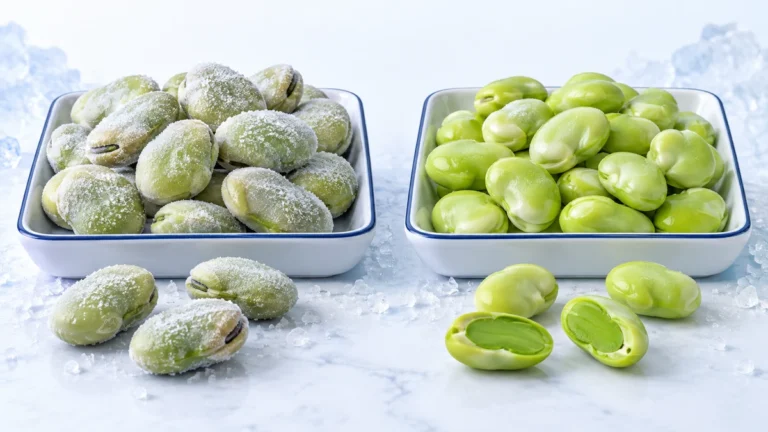
Shelled, peeled and split broad beans differ in seed-coat and kernel condition.

An inclined conveyor stands beside enclosed equipment inside the processing area.
We confirm whether the seed coat stays on and how remaining skin and fragments will be assessed.View related processing evidence →
A roller conveyor leads towards an opening in a panelled processing enclosure.

Connected conveyor sections run beside stainless-steel covers, controls and pipework.

A white transfer belt rises between the surrounding processing equipment.

A long covered line extends across the processing hall beneath overhead pipework.
We check incoming broad beans for maturity and kernel condition, identifying the source lot before the beans are prepared for the ordered form.
We clean and sort the beans; the selected form determines whether kernels remain shelled with coats, are peeled or are split. We establish the treatment and cooling requirements for that form.
We confirm how to freeze whole or split kernels and review the frozen beans for kernel damage, separation and residual skin where peeling is specified.
We check metal detection and package seals, verify broad bean lot labels, and document sample results and shipment details against the purchase specification.
Shelled: we supply shelled broad beans for cooked sides and recognisable bean inclusions. Peeled: we discuss peeled broad beans for recipes requiring the seed coat removed. Split: we match split broad beans to cooked soups and blended vegetable preparations. Select the packing family, case weight and label for the chosen product form and purchasing channel.

Application — updates the recommendation below
Packing family — updates the image and case options above
Pack construction: Food-grade PE liner and export carton; plain bag, adhesive label or printed bag; barcode and customized carton marks.
Loading plan: Pallet loading, floor loading or food-grade tote format as stated in the confirmed purchase order.
Shelled: Review split kernels, seed-coat condition and texture after the intended cooking cycle. Peeled: Review residual skins, kernel damage and colour after the buyer's cooking process. Split: Check residual skins, crushed particles and consistency during the proposed cooking cycle. Common food-safety checks remain part of the agreed inspection plan; form-specific physical and cooking checks follow the selected sample.

Photograph supplied by XMG for buyer review. We confirm which facility, test scope and release record apply to the quoted product.


Agree the measurable limit and sampling basis before sample approval.
Check the finished frozen lot against the signed product requirement.
We coordinate samples, specifications, inspection and laboratory records, packing checks and shipment documents from one commercial contact.
We use clear specifications, sample references and document checks to prepare an order. Use these blank worksheets to organize your requirements and the questions to discuss with us.
Check whether the company, facility, specification, report and proposed lot belong together before approval.
Track the specification, pack, artwork and document approvals needed for a proposed private-label SKU.
Use our published product and supply information to prepare your sourcing review.
Copy this prompt into an AI tool of your choice. Check its citations and confirm order details with us.
Start with the form, specification, application and pack. We coordinate samples, written specifications, documents and cold-chain handoff from one commercial contact.
Select the records required for this broad beans inquiry. Select one or several items. Your choices will travel with the product inquiry.
The order file includes certificate, production, product, lot and destination-market documents.
Your document request is ready to carry into the inquiry.
Tell us the broad beans form, kernel size band and skin-on or peeled identity, pack, quantity, destination and timing.
We provide the broad beans specification, sample plan, relevant document scope, packing and quotation basis.
Your written approvals and purchase order lock the agreed product, packing, document and shipment plan.
These answers cover the available product forms and the decisions needed for a detailed quotation.
Available forms include Shelled, Peeled, Split. Availability and the final tolerance are stated in the order specification; the first size reference is 15–25 mm kernel length.
State the selected form, declared size, packing, destination and intended preparation. Shelled: Specify kernel length and the acceptable variation with the seed coat retained. Peeled: Agree kernel size and the allowable remaining skin before approving the sample. Split: Record the natural half-kernel definition and acceptable small fragments separately.
Shelled: we supply shelled broad beans for cooked sides and recognisable bean inclusions. Peeled: we discuss peeled broad beans for recipes requiring the seed coat removed. Split: we match split broad beans to cooked soups and blended vegetable preparations.
Tell us whether skin-on, peeled or split beans are required. We will confirm the suitable China crop and factory option, then align size grade, pack and shipment timing.
Shelled: Review split kernels, seed-coat condition and texture after the intended cooking cycle. Peeled: Review residual skins, kernel damage and colour after the buyer's cooking process. Split: Check residual skins, crushed particles and consistency during the proposed cooking cycle.
Cook the shelled, peeled or split form needed by your recipe. Check kernel size, skin identity, mealiness, green colour and broken pieces. Send the skin-on or peeled requirement, kernel band, application and trial result; we will align the proposed form and its broken-kernel limit with the approved reference.
Yes, the selected shelled, peeled or split form affects fill, visible defects and handling during packing. Send the form, target bag weight, carton requirement and destination label brief; we confirm what the selected production route can pack and record the approved version. Review packing options.
Send the shelled, peeled or split form, destination and exact standard requested by your QA team. We will verify certificate holder, site, product scope and validity for the proposed facility before listing any certificate as applicable. See Food Safety Certificates.

Send the selected form, specification, packing, quantity, destination and target timing. We will prepare the supply and quotation details for your order.
IQF Frozen Broad Beans
Only your work email is required. Your product and selected specifications are attached automatically.
We use this information to review and respond to your product inquiry. See our Privacy Policy.
Tell us what you need. We’ll review your requirements and reply by email.
We use the submitted information to review and respond to your business inquiry.